
Watch a group of amateurs putt for a while and you start to see the same miss over and over. Not left, not right, not long or short exactly. Low. The ball rolls out, holds its line a beat too long, and dies on the amateur side of the cup, a foot below the hole, while the player leans and body-english's at a break that already won the argument.
I did it for years. And the maddening part was that it never felt like a bad putt. I'd hit it right where I was aiming, on my line, at a decent pace, and watch it miss anyway. So I'd chalk it up to a bad stroke, or a spike mark, or the greens being "off," and move on. The stroke was fine. The pace was fine. The read was wrong, and it was wrong in the same direction almost every single time.
This is the case for why your missed putts are mostly a reading problem rather than a stroke problem, why the miss leaks to the low side specifically, and how OpenSG scans the green's actual slope to show you the line your eyes are quietly refusing to believe.
The low miss never had a chance
Start with a piece of physics that sounds obvious and turns out to be the whole story. Gravity only pulls one way. A putt that's dying near the hole is being pulled toward the low side the entire time it's slowing down. So the two misses are not symmetrical.
Miss on the high side, the "pro side," and your ball is above the hole as it loses speed, with gravity feeding it down toward the cup. A high miss that's even slightly too much break still has a chance to catch the top edge and fall. It's dying into the hole.
Miss on the low side and the opposite happens. The ball is already below the line and slowing down, and gravity is pulling it further away from the hole. A low putt is dying away from the cup. It never had a chance. It was beaten the moment it started rolling on a line that didn't respect the slope.
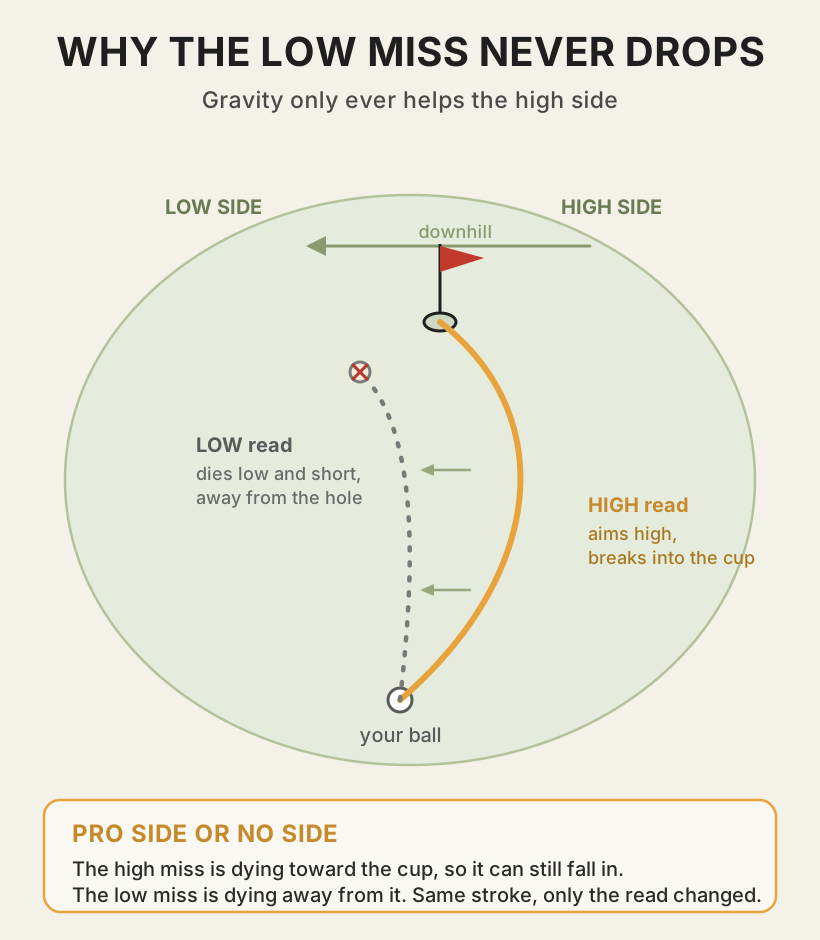
That's why good players preach playing enough break and missing on the high side. It isn't superstition. A high miss borrows a free chance from gravity. A low miss throws that chance away. And amateurs, almost universally, miss low, because amateurs almost universally under-read break.
New here? Learn how OpenSG works — we scan the green, roll a simulated ball, and show you the line your eyes can't see.
Why your eyes read half the break
Here's the uncomfortable truth about green reading on feel. Your eyes are bad at it, and they're bad at it in a predictable direction. They under-read.
A few things conspire against you. You're standing upright, looking down a putt at a shallow angle, and slope that's obvious from the side is nearly invisible looking straight down the line. Your brain anchors on the hole and imagines a straighter path to it than the ball can actually travel. And the break does most of its work at the end of the putt, where the ball is slowest and the slope has the most time to pull it, which is the part of the roll you're worst at picturing from behind the ball.
So you see some break, aim for some break, and it's almost always less than the green is actually going to take. You start the ball inside the true line. It holds on early while it's moving fast, then falls off the table at the end, low, and just short of where you needed it, and you blame the last thing that happened instead of the read that set it up.
And the raw slope you're trying to eyeball isn't even the real difficulty. What matters is the effective break: how much a putt curves once you account for slope and pace together. The same twelve feet plays completely differently below the hole on a gentle shelf versus above it on a fast downslope. Downhill, the ball spends longer slowing down, so the break compounds. Uphill, you hit it firmer, it holds its line, and the break barely bites. Reading a green is really reading that interaction, in your head, in the couple of seconds before you putt. It's genuinely hard. It's not a character flaw that you're bad at it.
What OpenSG actually sees
This is the part that felt like cheating the first time I used it.
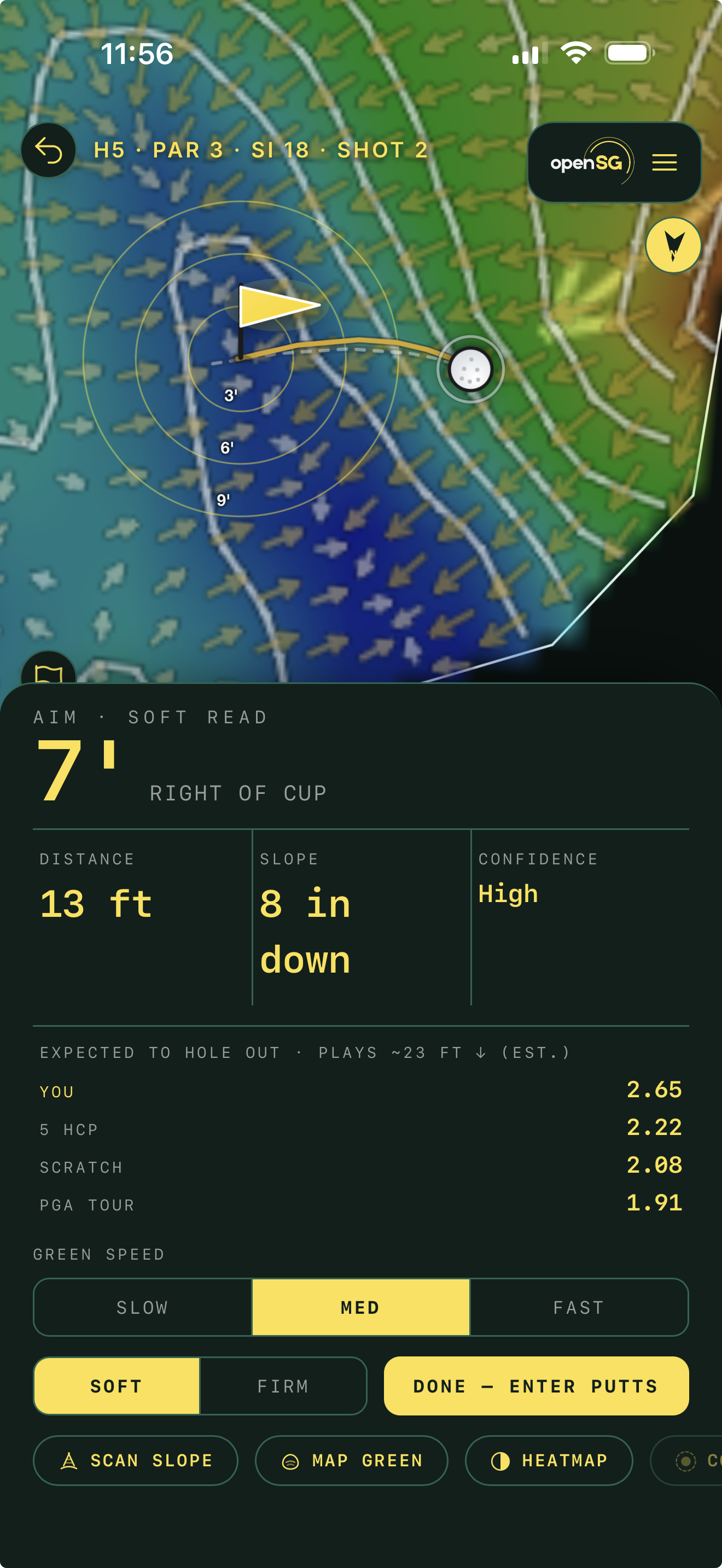
On a phone with LiDAR, OpenSG scans the putting surface and reconstructs the green's true contour in 3D, down to roughly a centimeter. Not a rough guess from a public elevation map, but the actual shape of the ground under your ball, ridges and shelves and all. Then it does the thing your brain is trying and failing to do. It runs a real physics simulation, rolling a ball across that slope field from your position to the hole, and finds the line that actually falls in.

What you get back isn't a vague "breaks left." It's an aim tunnel, a drawn line showing exactly where to start the ball, plus a plain-language read: aim four inches right of the hole. It's there the moment you step up to the ball, and it updates live as you move your marker or the pin. Reading it takes about as long as checking a yardage. There's no scan to run in the moment and nobody in your group left standing around waiting on you.
Ready to see the real line on your greens? Register now and read every putt with your phone.
The first dozen times I trusted it, my reaction was the same every time. That's way more break than I saw. Which is exactly the point. The scan doesn't have an ego, doesn't anchor on the hole, and doesn't get fooled by standing upright. It just simulates the roll. And nearly every correction it made to my read was in one direction: play more break, start it higher. The tool was quantifying the exact bias I'd had my whole golfing life. I wasn't a bad putter. I was a consistent under-reader, and I finally had a number for it.
When a putt is genuinely ambiguous, a double-breaker, or a spot where two lines both get there, OpenSG doesn't fake false confidence. It offers a few candidate lines you can pick between, each one validated in the simulation to actually reach the hole.
And here's the part that matters if you're not carrying the newest iPhone: you don't need the LiDAR scan to get a read at all. Every green in OpenSG already ships with baseline slope data, so the caddy hands you a line to start from anywhere you play, right out of the box. It won't be centimeter-perfect until the green has been scanned and played in, and the app tells you exactly that instead of pretending otherwise, but it still points you at the high side and gets sharper every round. The LiDAR scan is the precision upgrade, not the price of entry. And when a green does get scanned, it only takes one person one time, because that calibration is shared with everyone who plays it next. Out on the course you're never the one holding up the group to map a green. You open the read and go.
The green gets smarter every time it's played
Here's the part I think is quietly the coolest thing in the app, and it's invisible while you're using it.
A perfect elevation scan still isn't the whole picture, because the speed of a green (how much a given slope actually breaks a putt) changes with the grass, the moisture, the mow. So after a missed putt, OpenSG asks you one tap: did it break more than you expected, less, not at all? And it watches where your putts actually finish. A made putt is the strongest signal there is, a known-good line and pace, confirmed by the ball going in.
Those real outcomes fold back into a per-green correction that bends the physics read toward what putts on that green actually do. And because it aggregates on the server, the calibration ships to the next player. Every putt everyone hits makes the read a little better for the next golfer who stands over that same line. The green you scan today is a little smarter for the next person, and their greens are smarter for you. It's the rare feature that improves while you sleep.

More on where you actually lose strokes — browse the OpenSG blog.
Reading isn't the only way you leave it low
There's a sibling to the low miss, and OpenSG will show it to you in your stats: leaving the putt short. The two failures rhyme. A putt hit too softly spends more of its life slowing down, which means gravity has more time to drag it low. So under-hitting and under-reading compound into the same sad result, a foot below and a foot short.
That's why the app's putting analytics don't just count makes and misses. For makable putts, they split your misses into made, missed-short, and missed-long, because leaving it short is the cardinal error. A putt short of the hole is a putt that was never going in, same as a putt below it. For lag putts, they track how many you finish inside a comfortable tap-in range. If your strokes-gained putting is bleeding, this is where you find out whether it's a read problem, a pace problem, or both.
The point is that "I'm a bad putter" is almost never a useful diagnosis. "I under-read right-to-left putts and leave them low" is. One you can fix. The other you just carry around and apologize for.
Where you leave the ball decides the read you get
If you've read our posts on picking an aim point, on why the smart target on an approach is almost never the pin, this is the same idea reaching all the way onto the green.
That series made the case for aiming at the fat, low side of the hole to dodge the expensive miss. Here's the quiet bonus that argument buys you. Below the hole, the putt is uphill, and uphill putts break less. You hit them firmer, they hold their line, and the read you're forced to make is the easy one. Miss your approach long or above the hole and you inherit a fast, downhill, heavily-breaking putt, the exact putt your eyes read worst and gravity punishes hardest. The three-putt you'll blame on your stroke was really handed to you by where the ball came to rest.
So the whole chain links up. Aim your approach to leave yourself below the hole. Below the hole, the putt breaks less and runs uphill. Uphill, your under-reading and your short-pace both matter less. And when the read is tricky, let the scan show you the real line instead of trusting the eyes that have quietly cost you a putt a round for years. Good putting starts two shots before you ever pull the putter.
Train your read, then measure it
Spotting the bias is one thing. Drilling it out is another, and reading greens is a skill you can practice with real feedback, the same way you'd hit putts to a tee. OpenSG has a drill built for exactly that: the break-read quiz, on the Putting Practice tools. Pick a course and a green and it runs entirely off the stored slope data, so you don't need LiDAR or GPS.
The loop is simple. You set the green speed, place the hole where a real tee sits, and if you like, trace the patch of green you actually putt from. Then the app drops a ball in that zone and shows you the green with the line hidden. You commit to a read and tap where you'd aim, and only then does it reveal the truth: the real breaking line, drawn as an acceptance tunnel between the firm and soft speeds that both hole it. Aim anywhere inside the tunnel and it drops.
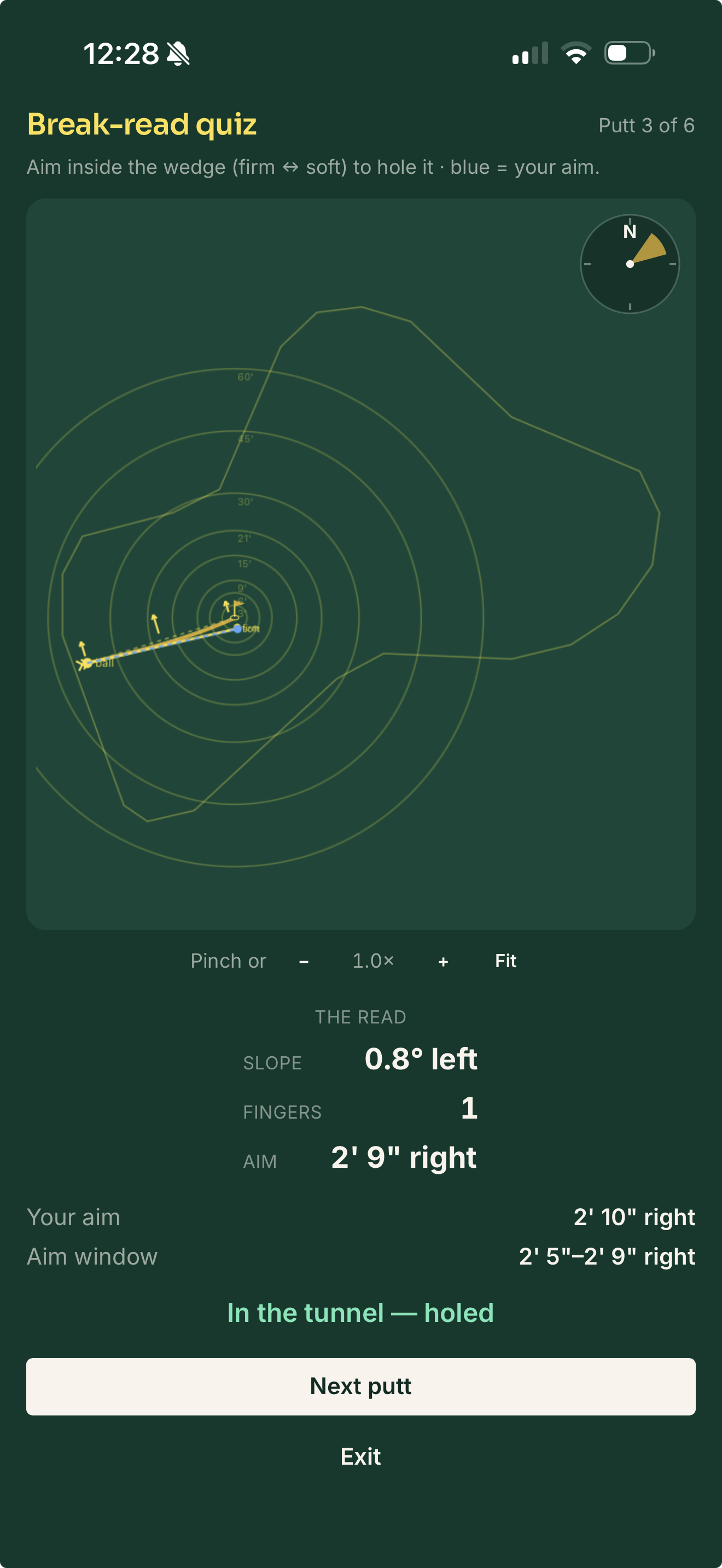
The concealment is the whole point. You have to commit before you see the answer, which is the same pressure a real read puts on you, and it's the only honest way to find out whether your eye is fooling you. Six putts to a round, and at the end it hands you the number that matters most for this whole article: how many you holed, and which way you missed. "2 high, 3 low" in plain text is the amateur under-read staring right back at you.
And because the drill runs on the exact same read the on-course caddy uses, the reps carry straight over. You are not learning a game. You are calibrating the same eye you will use over a real putt, on a green you actually play, until playing enough break stops being advice and starts being a habit.
The quiz sharpens the read. Its sibling drill, the putting benchmark, measures the whole skill. Same setup, but now you hit the actual putt and tell the app whether it holed or tap where it finished. It steps down a ladder of distances, prices every putt in Strokes Gained against the baseline you pick, and turns the result into a putting handicap you can track. The quiz is throwaway; the benchmark trends over time, so you get to watch the number fall as your reads and your pace get honest. One drill trains the eye, the other keeps score, and neither one touches your on-course handicap or Strokes Gained. Practice lives in its own ledger, the way the range does.
So what do you actually do about it?
Assume you're under-reading, because you probably are. The amateur bias is real and it's one-directional. When you're between two reads, take the higher one. You will almost never regret playing too much break.
Aim to miss on the high side. Give the putt a chance to fall in on the last roll instead of dying away from the hole. "Pro side or no side" is a cliché because it's true. The high miss borrows from gravity, the low miss donates to it.
Let the read recalibrate your eyes. Ask OpenSG to help read the putt whenever you want a line. The scan is optional, and the advice is ready when you are. Pay attention to how much the read disagrees with your gut. That gap is your personal reading bias, and once you can see it, you can start correcting for it even when you're reading by feel.
Never leave it short of the hole. Short and low are the same mistake wearing two hats. A putt that dies before the hole was never in, and a dying putt drifts low on its way to nowhere. Get it there.
Set up the easy read one shot early. Below the hole beats above it, uphill beats downhill, flat beats sloped. Your approach and your aim point choose which read you'll face. Choose the gentle one.
I spent years grinding my stroke on the practice green, convinced I was a streaky putter who just couldn't buy one. The stroke was never really the problem. I was reading half the break, missing low, and blaming my hands for what my eyes never saw.
Turns out the green knew the line the whole time. I just needed something that could actually see it.