You know the feeling. You stripe a drive, you find the green in regulation, you're standing on the dance floor looking at a birdie. And then you three-jab it and walk off with a bogey, muttering about how you have to get on the practice green and fix your putting.
I said that to myself for years. Then I started tracking every shot with strokes gained in OpenSG, went looking for my putting problem, and found something annoying. I didn't really have one. The 3-putts were real, the frustration was real, but the stroke I was losing had almost nothing to do with my putter. It was being lost a hundred and fifty yards earlier, and my putter was just where the evidence washed up.
This is the case for why your 3-putts probably aren't a putting problem, and how strokes gained lets you trace the crime back to the actual culprit.
First, what actually causes a 3-putt
Here's the thing nobody wants to hear. 3-putts are almost entirely a function of distance, not stroke quality.
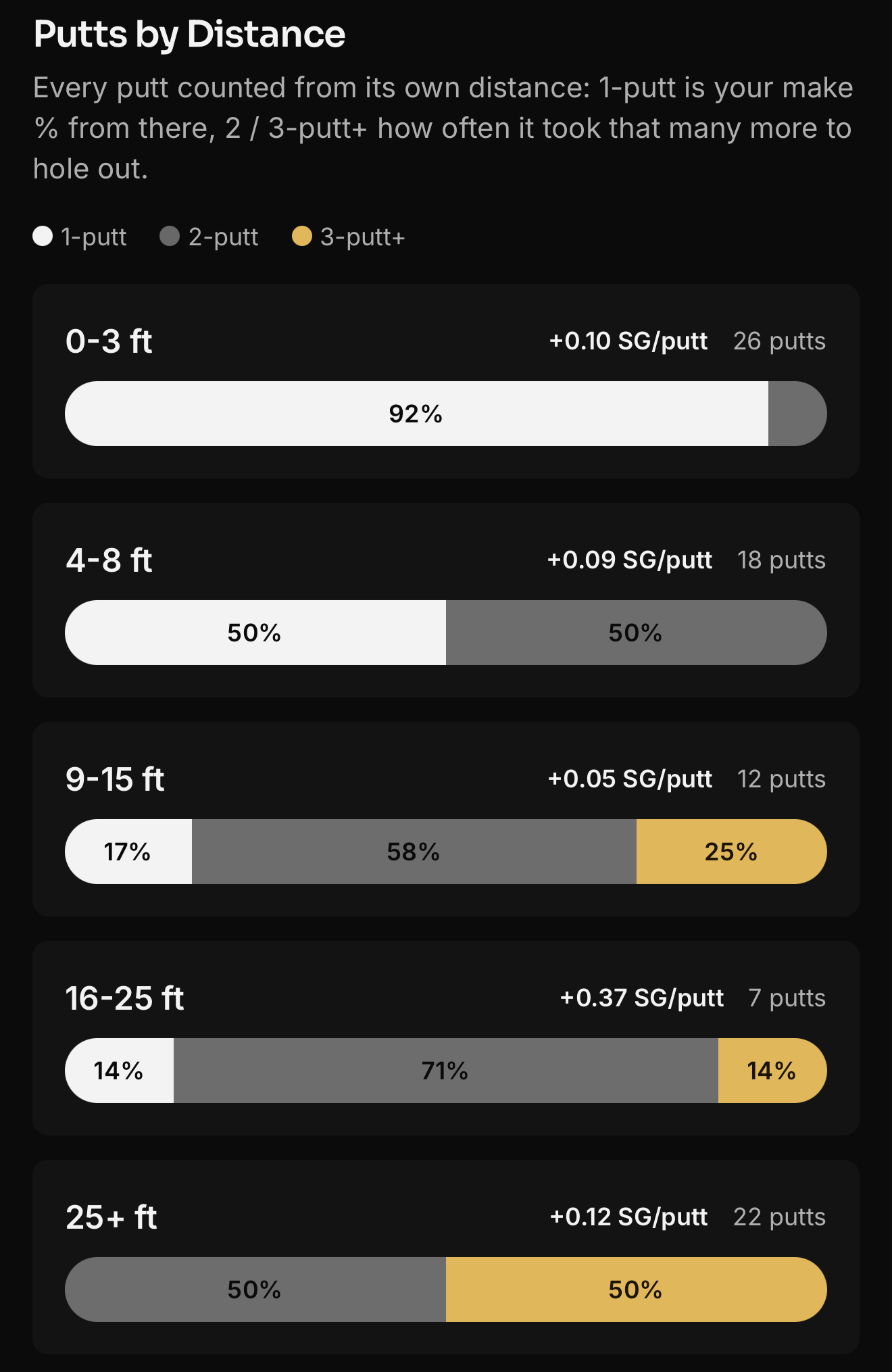
Look at how three-putt probability scales with the length of your first putt. From inside 10 feet, a 3-putt is nearly impossible. Even weekend amateurs three-putt from there only a couple percent of the time. Through the mid-range it creeps up slowly. And then somewhere around 35 to 40 feet, it spikes. From 40+ feet, amateurs three-putt something like 20 to 30 percent of the time. This isn't a skill gap you can grind away, either. Even tour professionals, the best putters on Earth, three-putt around 15 percent of the time from 50+ feet. It's just hard to cozy a 45-footer up to gimme range and then pour in the comebacker.
New to strokes gained? Learn how OpenSG works — it pins down exactly which part of your game is costing you.
Flip that around and the insight jumps out. Nobody three-putts from 15 feet often enough to matter. Three-putts live almost entirely in the long-lag zone. So the single biggest thing determining your putting score isn't the smoothness of your stroke. It's how often you're standing over a 40-footer in the first place.
And how often are you standing over a 40-footer? That's not a putting question at all.
How strokes gained gives your putter an alibi
To see why the putter is innocent, you have to understand how strokes gained scores a putt. Every shot in golf has an expected-strokes value, the average number of strokes it takes to hole out from that exact spot. From 3 feet the baseline is barely over 1. From 40 feet it's comfortably over 2. Strokes gained is just the difference between where you started, where you ended up, and the one stroke you spent getting there.
That baseline is the whole trick, because it means two-putting from 40 feet is exactly par for the course. You don't lose any strokes putting when you two-putt a long one. You did what was expected. You only lose strokes on the green when you putt worse than the baseline for the distance you were given.
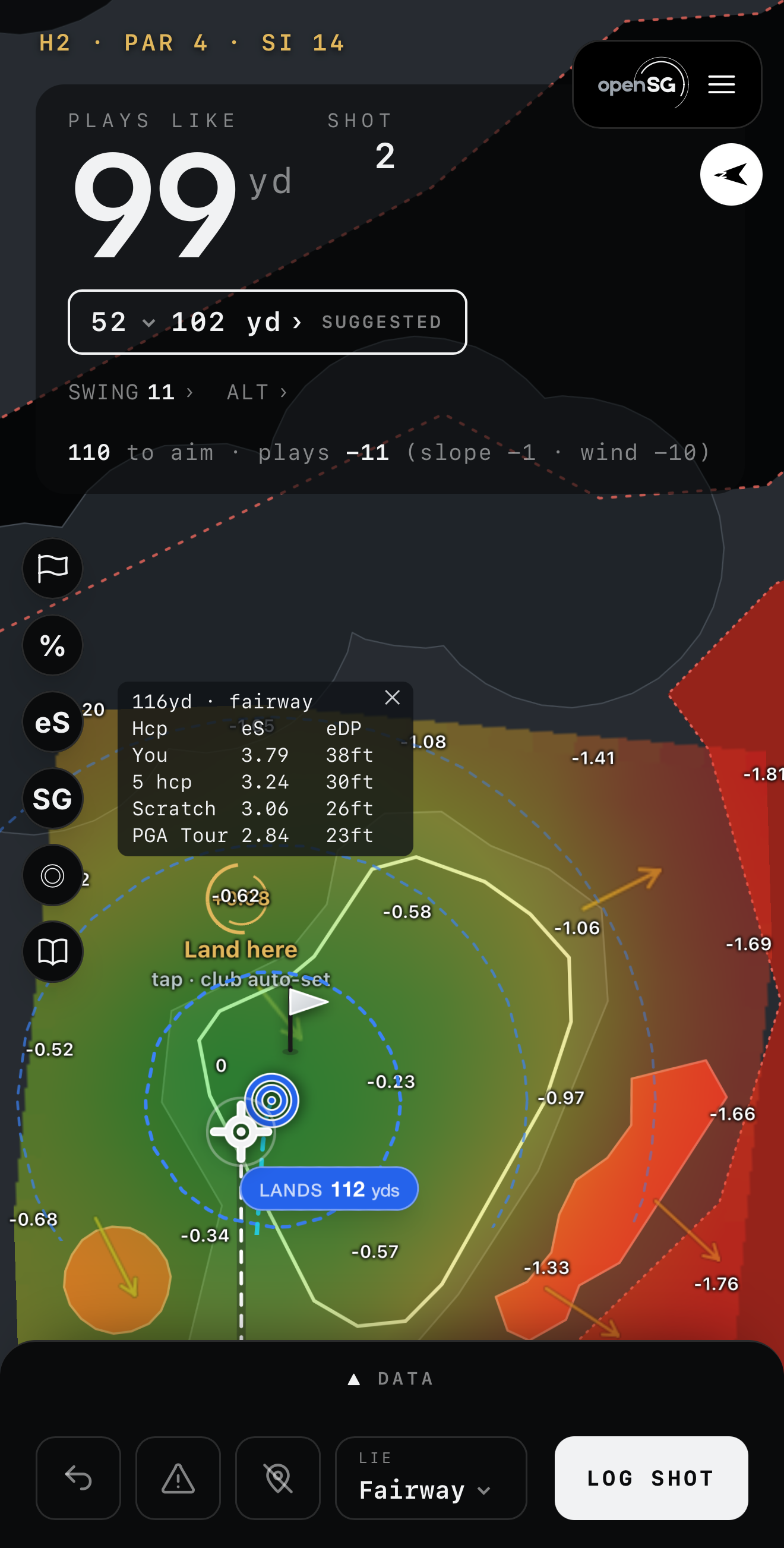
This is exactly what OpenSG puts in front of you. Every shot you take carries its expected-strokes number, so you can tap a first putt from 45 feet and see what it's actually worth. And here's the part that closes the case. You can flip the baseline between your handicap, scratch, and tour pro and watch how little it moves. From 45 feet, a mid-handicapper is looking at roughly 2.2 expected strokes to hole out. A scratch golfer? About 2.1. A tour pro? Right around 2.1. I pulled that number straight out of the app. Even the best player alive two-putts from 45 feet. The entire putting gap between you and a professional from that distance is a tenth of a stroke.
And even that 40-foot number isn't really about the raw feet. Tap two putts the same distance from the hole and OpenSG can hand you two very different expectations, because what it actually scores is the effective distance, slope and all. Here are two of mine, both sitting about 40 feet away:
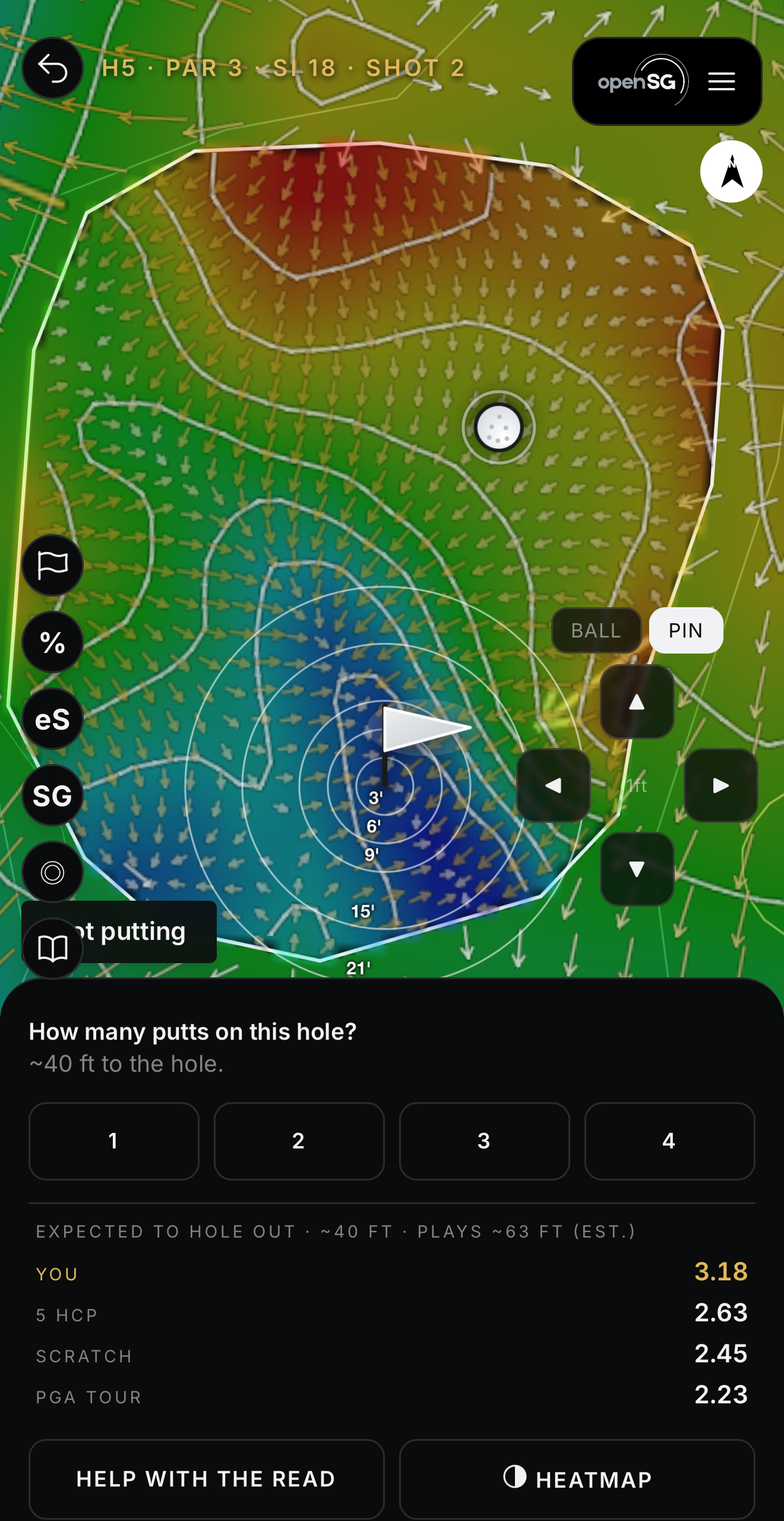
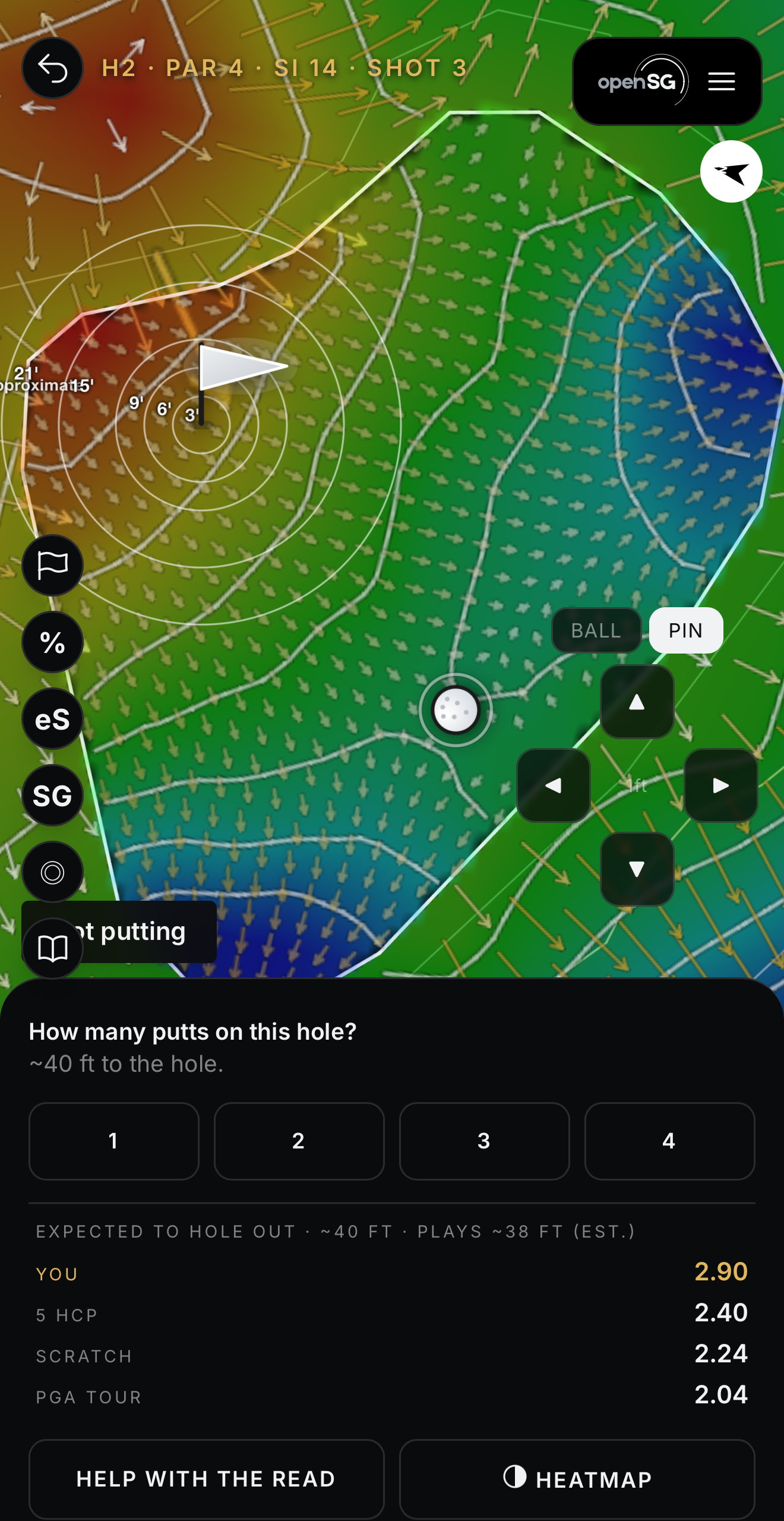
Same forty feet on the scorecard. The one on the left is uphill into a tier, so it plays like 63 feet. Even a scratch golfer is expected to take about 2.45, and I'm looking at 3.18. The one on the right runs on a calmer line, plays like 38, and the whole field's number falls roughly a quarter-stroke. Distance alone doesn't set the difficulty of a lag putt. The plays-like distance does. And notice what actually handed me the gentle one versus the brute. My approach. Whether it left me below the hole on a flat shelf or above it on the slope. The green just collects the bill.
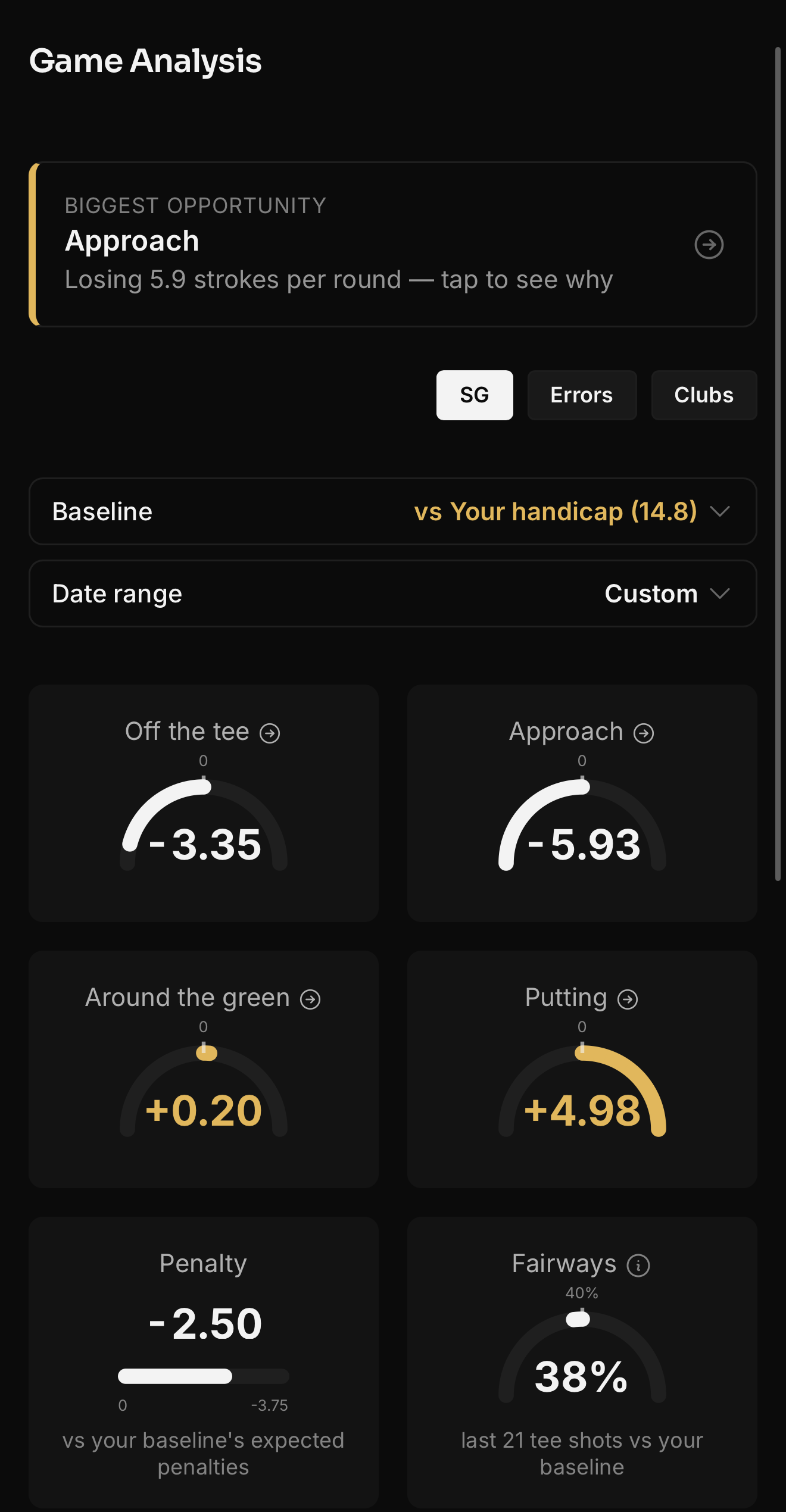
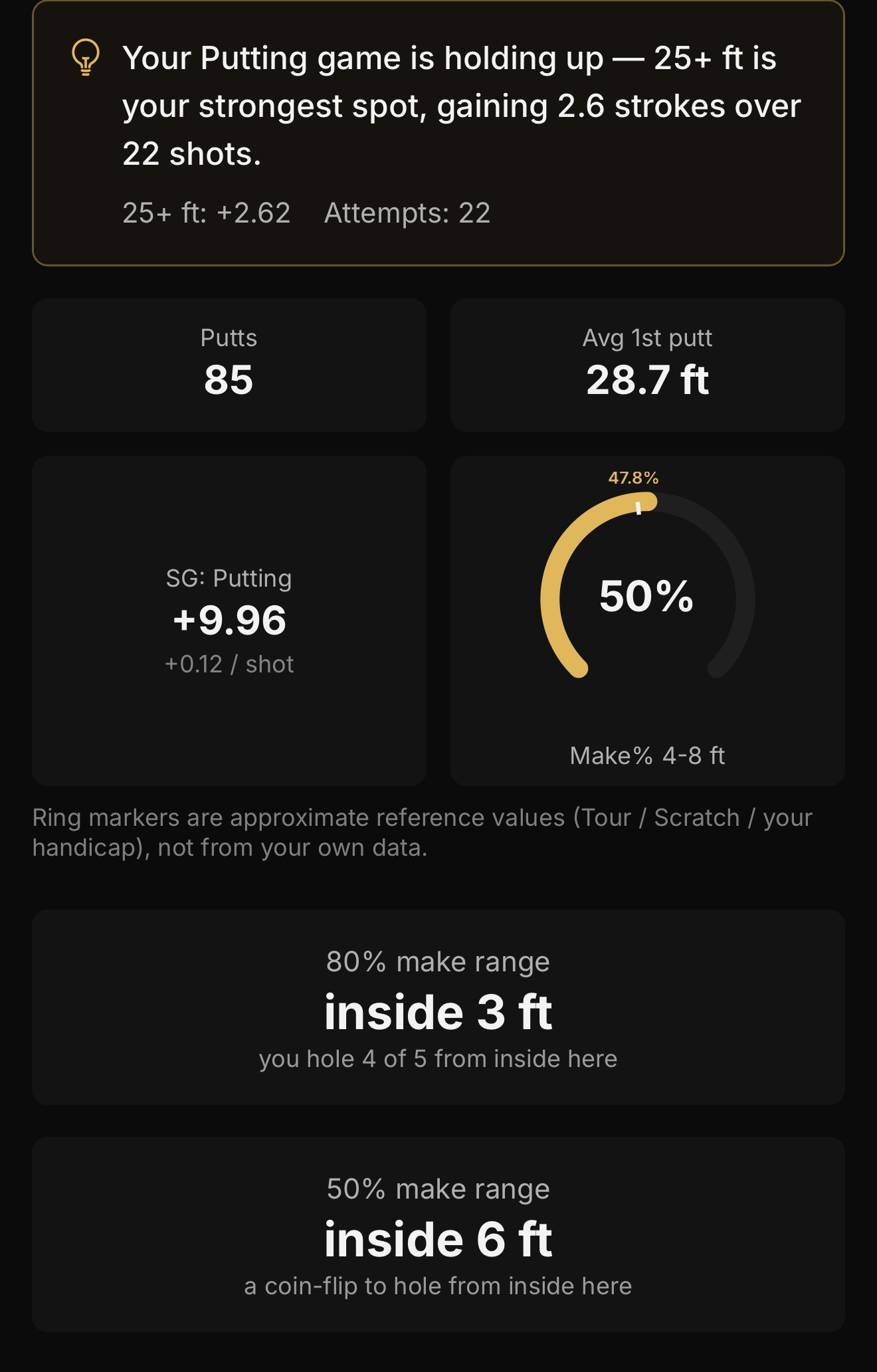
So here's the reveal that reframed my whole game. I had rounds absolutely littered with three-putts, and when I finally looked, my strokes-gained-putting number wasn't just neutral. It was strongly positive. Putting was quietly one of my best categories, and I was still walking off the green blaming it. I was holing my share and lagging the rest close enough. The three-putts I did have weren't a stroke failure. They were the mathematically expected outcome of standing 44 feet away over and over again.
Want to see your own five-category breakdown? Register now and OpenSG will tell you which part of your game is actually costing you strokes.
That's the alibi. The ledger doesn't lie. When your putting SG is flat but your scorecard is full of three-putts, the strokes leaked somewhere else and just came due on the green.
Tracing the cause backward
This is where strokes gained stops being a scorekeeper and becomes a detective. The whole point of splitting your game into categories (off the tee, approach, around the green, putting) is that you can walk a bad hole backward and find where it actually broke.
The chain looks like this. I three-putted. Why? Because my first putt was 44 feet. Why was I 44 feet away? Because my approach shot finished 44 feet from the pin. There's the miss. The stroke didn't evaporate on the green. It was baked in the moment my 8-iron came down on the wrong side of the green and released to the back edge.
OpenSG makes this walk-back literal. That 45-foot first putt is worth about 2.2 strokes for me and about 1.9 for a scratch, a fingernail of difference. But look at the approach that created it. A pro from 125 yards in the fairway is expected to leave the ball around 18 feet and take about 2.8 strokes to get down. I left it at 44 feet and needed about 3.2. That 0.4-stroke gap didn't happen on the green. It happened in the air. Switching the baseline on the approach shot is where the daylight opens up. Switching it on the putt is where it stays shut. That contrast, shot by shot, is the whole diagnosis.
When I traced my three-putts back this way, they almost all had one of two fingerprints.
Raw proximity. I was simply too far away. If your approaches average 38 feet, you are going to live in the three-putt zone whether your stroke is buttery or not. There's no lag drill that fixes "I keep hitting it to the fat 40 feet from the hole."
The wrong-side miss. This is the sneaky one, and it's the one proximity alone completely hides. A 25-footer from below the hole, on the correct tier, on a mellow slope, that's a routine two-putt, basically a non-event. The same 25 feet from above the hole on a fast downslope, or from across a ridge, plays like a 40-footer. Your "distance" says 25 but your three-putt risk says 40. I had a whole category of "short" putts that were quietly murderous because I was constantly short-siding myself or ending up above the hole. That's not a putting stat. That's an approach-and-aim stat.
Put two numbers side by side: approach proximity and first-putt distance
OpenSG surfaces the exact pair you need to run this diagnosis yourself. In your approach analytics there's average proximity, how close your approach shots finish to the hole. In your putting analytics there's average first-putt distance, how long your first putt is on the greens you actually putt.
At a glance they look like they should be the same number. They aren't, and the gap between them is the story of your short game.
They measure genuinely different things:
- Approach proximity counts where your approach finished, including the shots that came to rest close but off the green, in the fringe, the rough, or a greenside bunker. It's the raw quality of your ball-striking into the green, hazards and all.
- First-putt distance only counts actual putts. If you missed the green and then chipped on, the number it records is the length of the putt after the chip, not where your approach left you. A crisp chip to 4 feet shows up as a 4-foot first putt, even though the approach that set it up finished 40 feet away and off the surface.
So the two numbers pull apart in a way that's informative rather than confusing:
If your first-putt distance is a lot shorter than your approach proximity, your short game is rescuing you. You're missing greens, but your chipping is dragging your first putts down into comfortable two-putt range. Your three-putts may not be the headline problem, but your approach still is, because you're leaning on up-and-downs to cover for it, and that's a bet that eventually stops paying.
If the two numbers are close, most of your first putts are coming straight off your approaches. You're hitting greens, just not close enough. Here your approach proximity is your three-putt exposure, undiluted. This is the purest version of the whole thesis: shorten the approach and the three-putts disappear with it.
Either way, hold your first-putt distance up against the 40-foot line. That's the number that most directly predicts three-putts, because it's what you're actually facing on the green after your approach and your short game have both had their say. If your average first putt is creeping into the high 30s, you're living on the doorstep of the three-putt zone. That's your cue to look upstream at proximity and decide whether to practice approaches, chipping, or both.
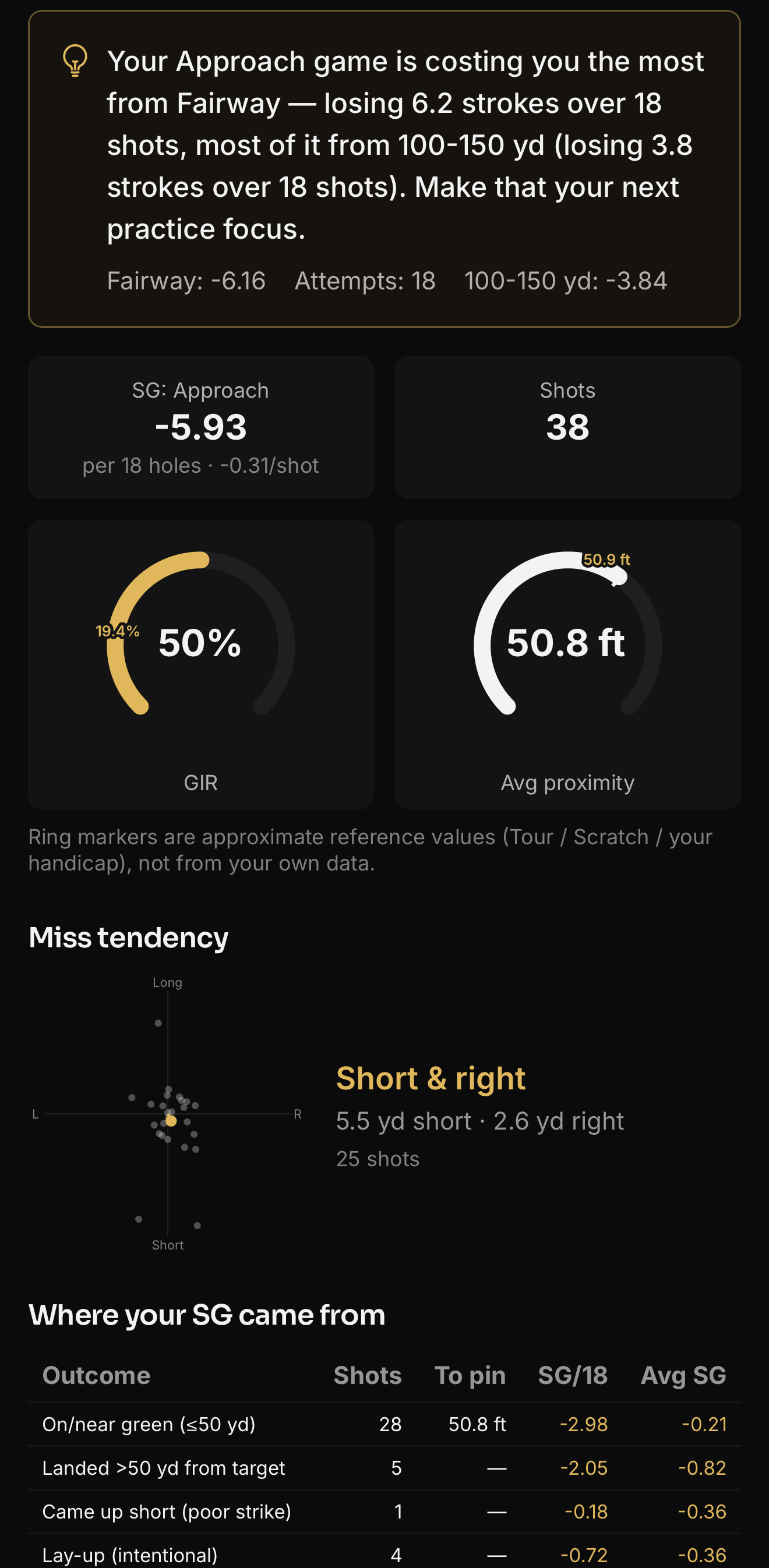
Here's what mine actually look like, warts and all. My approaches finish an average of 50 feet from the hole, against a target of about 29 feet for my handicap, and I hit only half my greens. Genuinely bad. But my average first putt is 29 feet, more than twenty feet closer than my approaches finish. That gap is my short game working overtime. I'm missing greens all day and chipping the ball back to a two-puttable range to cover for it. It's the whole reason my strokes-gained shows me bleeding on approach while putting is one of my strengths. The three-putts I do rack up were manufactured 130 yards out, not on the green.
Read them together and the mystery evaporates. Approach proximity is the root cause, first-putt distance is the symptom you feel on the green, and the gap between the two tells you exactly how much your short game is quietly papering over.
What good actually looks like from 100–150 yards
If the leak is your approach, the next question is the honest one. Is my wedge game actually bad, or does it just feel bad? This is where you stop guessing and look at your dispersion.
Enjoying this? Browse the rest of the OpenSG blog for more strokes-gained deep dives.
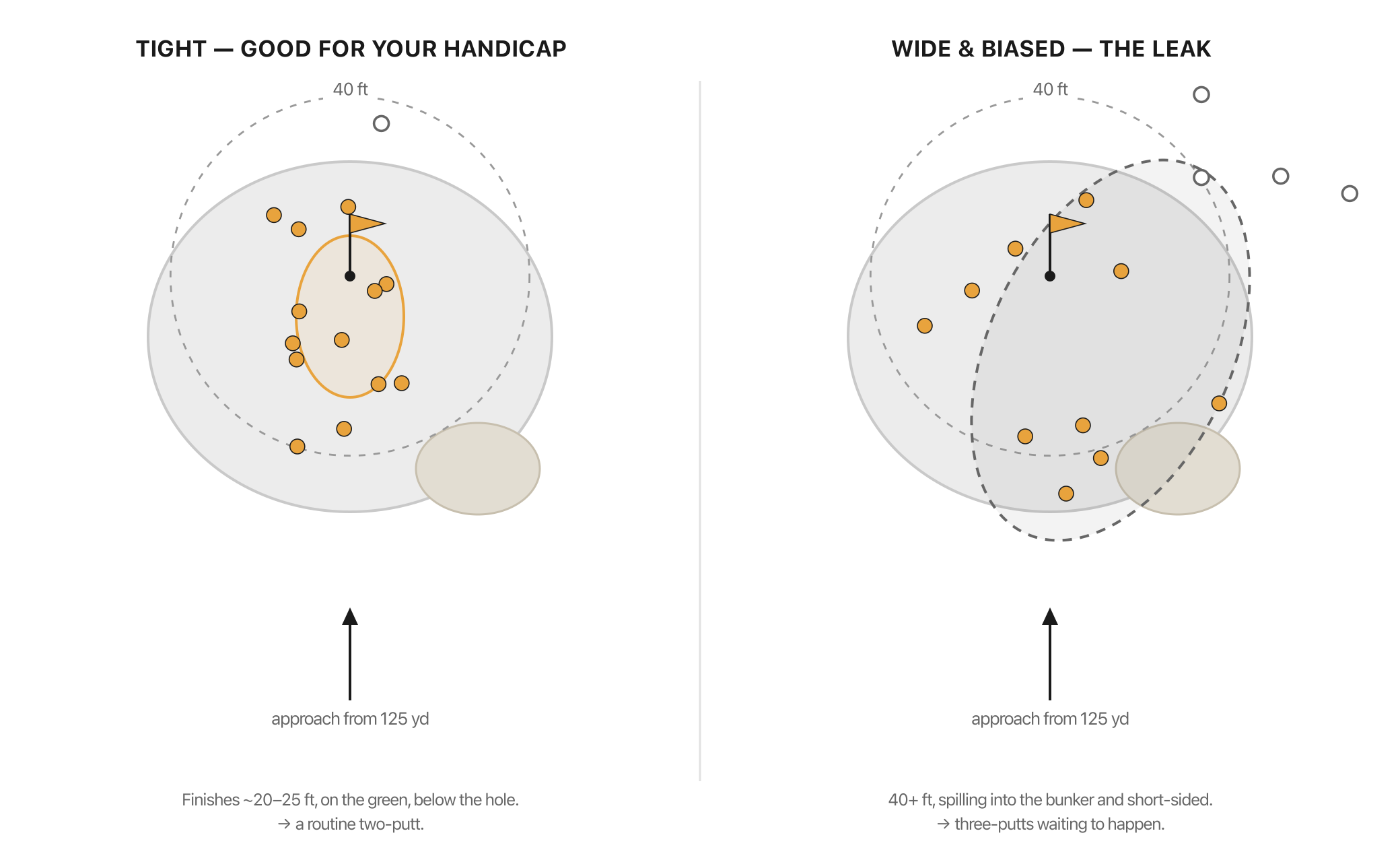
Open your scoring clubs in OpenSG and you'll see the real shape of your misses, an ellipse fit from your own tracked shots, not a guess. A few benchmarks to judge it against, from the fairway in that 100–150 yard scoring zone:
- Tour pros average roughly 18 feet of proximity from 100 yards and about 24 feet from 150, and they hit the green from that range around 80–90% of the time.
- A scratch amateur is closer to 25–30 feet, greens in the 65–75% range.
- A 10-handicap is out around 35–45 feet and misses the green something like 40% of the time from 150.
- A 15-to-20 handicap is 45+ feet on a good one and hits fewer than 40% of greens from 150.
Notice how modest the pro number is. The best players in the world average two-plus club-lengths from the hole with a wedge in hand. If you're expecting to hit it stiff, you're benchmarking against a fantasy, and then treating the resulting 40-footer as a putting problem.
Two things matter more than the raw average, and OpenSG shows you both.
The shape of the ellipse. For scoring clubs, your biggest enemy usually isn't left-and-right. It's long-and-short. A well-struck wedge doesn't spray sideways much. It flies the wrong distance. So a good short-iron dispersion is one that's tight front-to-back, ideally with your distance error inside about one club's worth of yardage. That matters enormously here, because long-and-short is exactly what leaves you above or below the hole. Distance control on your wedges is, quietly, a putting stat. A good target from ~125 yards is a pattern that keeps you inside roughly 25–30 feet most of the time, with the long/short spread tighter than the sideways spread.
Whether it's good or bad for you. This is the number that actually matters, and it's why the baseline toggle is the killer feature. OpenSG shows the strokes gained your dispersion is producing against the baseline for your handicap, so you find out whether your 120-yard game is gaining or losing versus a golfer of your exact index. Then flip it to scratch and tour to see your ceiling. You might discover your wedges are actually fine for a 14-handicap and the real leak is your 175–200 yard approaches. Or you might discover the opposite. Either way you stop practicing on a hunch.
And there's a bonus. This same dispersion ellipse is what powers OpenSG's optimal aim point. A wide or biased pattern is why the smart aim shifts off the flag, and as your dispersion tightens, the app will show you aiming closer to pins, leaving shorter first putts, shrinking your three-putt exposure automatically. The stats and the strategy are the same data wearing two hats.
Why grinding lag putts barely moves the needle
Now, I'm not saying distance control is worthless. If you're genuinely leaving 40-footers 8 feet short, that's a real leak, and OpenSG will show it, because your putting SG will actually be negative, not neutral. But for most golfers, hammering lag putts is optimizing the symptom while the disease runs free.
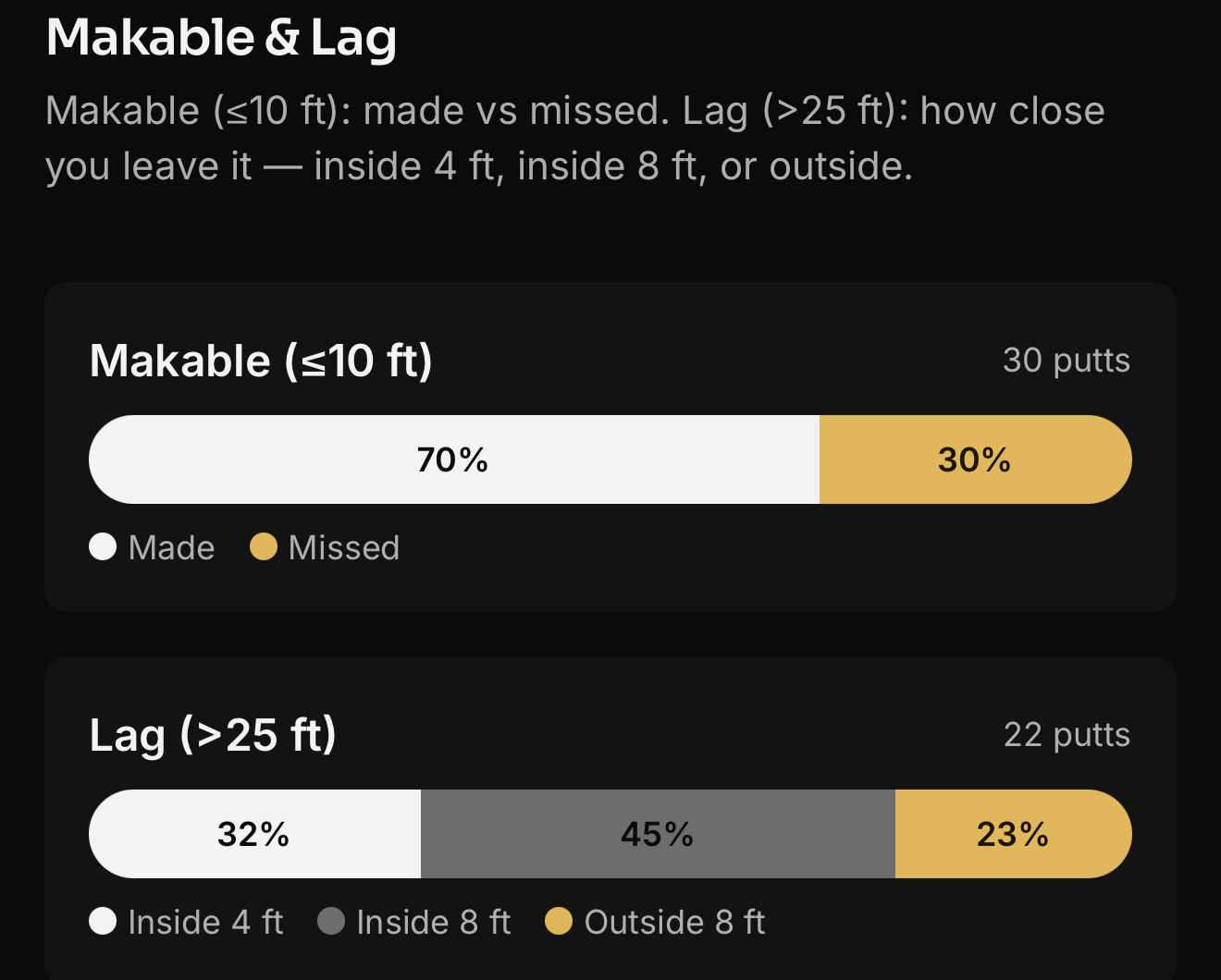
Run the rough math on where a practice hour actually goes. Tighten your lag dispersion by a foot or two and you'll shave your three-putt rate a little, a fraction of a stroke over a round on a good day. Now instead move your approach proximity from 40 feet to 30 feet. You don't just make the lag putts a hair easier. You delete whole three-putt situations from the round, because 30-footers three-putt far less often than 40-footers, and you'll sink a few more of them too. Same hour of practice, and the approach work buys multiples of the strokes.
Practice time has an opportunity cost. The reason "work on your putting" feels productive is that the three-putt is the last thing that happened, so it's the freshest wound. But the freshest wound is rarely the deepest one, and now you have a tool that tells you which is which.
This is the other half of picking your aim point
If you read our last post, about why the optimal place to aim your approach is almost never the pin, this is the sequel, and the two lock together tighter than they look.
That post made the case for aiming at the fat part of the green and biasing away from the expensive miss, and the argument there was about hazards. Don't let your dispersion leak into the water when the bunker is right there. But there's a second, quieter reason the smart aim isn't the flag, and this post is it. Your aim point also decides what kind of first putt you leave yourself.
Think about what OpenSG's expected-strokes engine is actually doing when it picks a target. It isn't just sorting outcomes into "on the green, good" versus "in the bunker, bad." It knows that a 40-foot first putt is worth measurably more strokes than a 15-footer, and it accounts for the green's slope carrying your ball above or below the hole. So the aim that truly minimizes your expected score is automatically nudging you toward closer, flatter, below-the-hole first putts. It is designing your three-putts out of the round before you ever make a swing.
That's the beautiful part. The three-putt and the aim point are the same decision seen from opposite ends. Pick the aim that leaves the tap-in-friendly first putt, and your "putting" improves without a single putting drill. It's also why greenside slope matters so much. The very same tilt that can feed a good-looking approach off the green and into the water can also leave you pin-high but above the hole, staring down a slippery downhill four-footer. Where the ball comes to rest after it lands is the hinge between a stress-free two-putt and the three-jab you'll wrongly blame on your stroke.
Aim isn't just about avoiding the big number. It's about setting up the small one.
So what do you actually do about it?
Diagnose before you treat. Pull up your strokes-gained split in OpenSG. If your putting number is hovering around neutral but your gut keeps blaming your putter, believe the number. Your leak is upstream. Don't spend hours fixing something that isn't broken.
Audit your scoring-club dispersion. Look at your 100–150 yard ellipses, check the SG they produce against your handicap baseline, and find out whether your wedges are gaining or bleeding. Pay special attention to your long/short spread. That's the number quietly setting up your three-putts.
Practice the cause, not the symptom. Trade some of that lag-putting time for approach reps at your real scoring distances. And when you practice approaches, aim at a spot that leaves the flat side of the hole, not at the flag. You're training the decision as much as the swing.
On the course, choose the correct-side miss. Pin-high and below the hole beats hole-high and short-sided every single time. Missing on the fat, low side isn't a bailout. It's the play that turns a would-be three-putt into a stress-free two.
Reframe the three-putt when it happens. Instead of "what's wrong with my stroke," ask "how far was that first putt, and how did I end up there?" Do that for a few rounds and you'll stop seeing a putting problem and start seeing an approach pattern.
None of this means you should never work on your putting. Short putts inside 6 feet are their own real skill and absolutely worth practicing. Miss enough of those and the SG ledger will correctly point at your putter. But the three-putt, the specific thing that ruins the good hole and sours the round? That one almost always has an alibi, and the fingerprints are back on the fairway.
I spent years trying to fix my three-putts on the practice green. Turns out you don't fix them there.
You fix them 150 yards away.