Every golfer has stood on a tee and asked the same question. Where do I actually aim? Not at the pin. At the smart spot, the one that gives up the fewest strokes over a full round.
That question is the whole reason OpenSG exists, and the answer is surprisingly computable. Here is how the app does it, from a tee shot down a dogleg to a lay-up short of a creek, and how it stays fast, offline, and trustworthy right there in your pocket.
The one idea underneath everything
Tee shots, approaches, and lay-ups are all the same problem. We never ask "is this aim good?" We ask "how many strokes does this aim cost on average, given that you're not a robot?"
On average is the key part. You don't hit the ball exactly where you aim. Nobody does. So for any target we build a cloud of where your ball might actually end up, drop a couple hundred simulated balls into it, and see how each one turns out. Some land on the green. Some catch a bunker. One or two find water. We add up the real cost of every outcome and take the average. That number, in strokes, is the target's score. The best aim is simply the target with the lowest one.
Strokes Gained is the currency. Every landing spot gets a price from a baseline table: from this lie, at this distance, how many strokes does a golfer at your level need to hole out? The fairway is cheap. The trees are expensive. Water costs a penalty stroke plus the shot you play next. Add one for the shot you just hit, and you have the expected strokes to finish from there. Average across the cloud and you're done.
Want the plain-English version first? Learn how OpenSG works — what strokes gained is and why it's the number that matters.
Where the cloud comes from
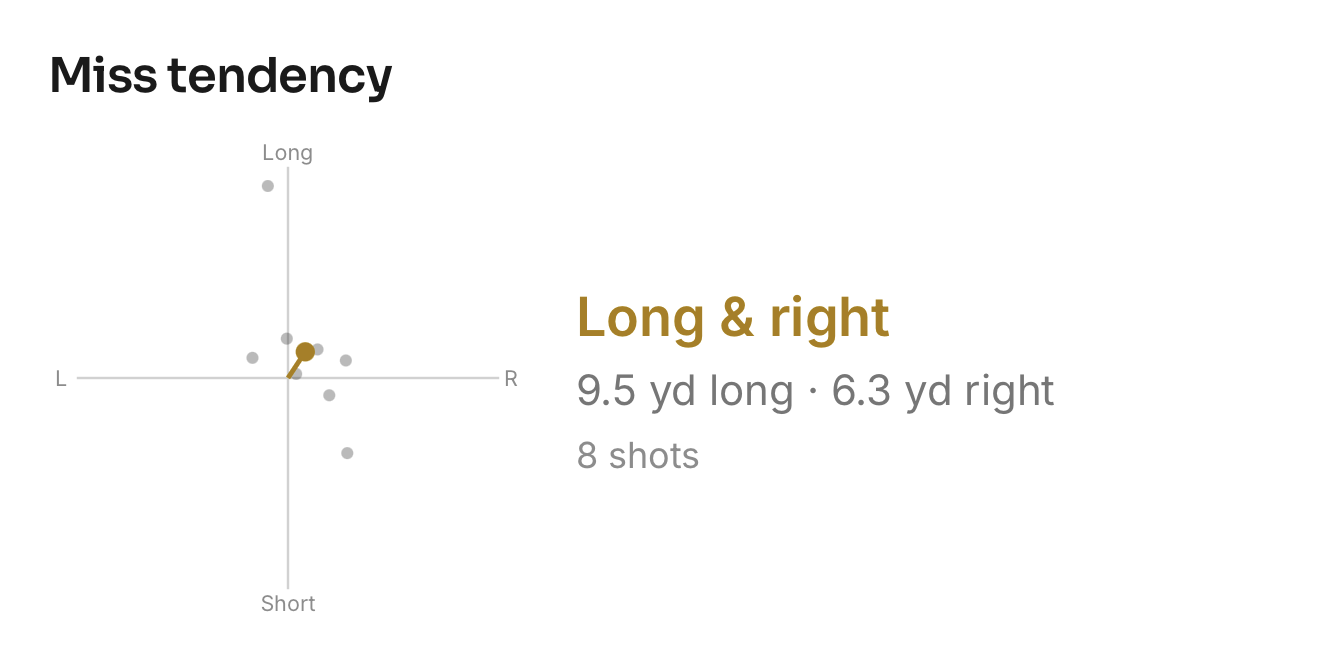
The cloud isn't a guess. It's fitted from your own shots. Every club has its own dispersion ellipse, longer along the flight line than across it, because most players scatter more in distance than in direction. We also track a mishit rate, the small fraction of swings that go badly wrong. Those fatten the tail of the cloud, so the sim doesn't pretend you're more consistent than you are.
Then we sample it: 240 points, laid out to match a normal distribution. And here's a choice that matters more than it looks. The samples are fixed, not random. Same club, same target, same answer, every time. Random sampling would make the recommended aim jitter a yard or two whenever you nudged the ball, which feels broken even when it's technically fine. Fixed samples also make the whole thing repeatable, which pays off later.
Approaches: sweeping around the green
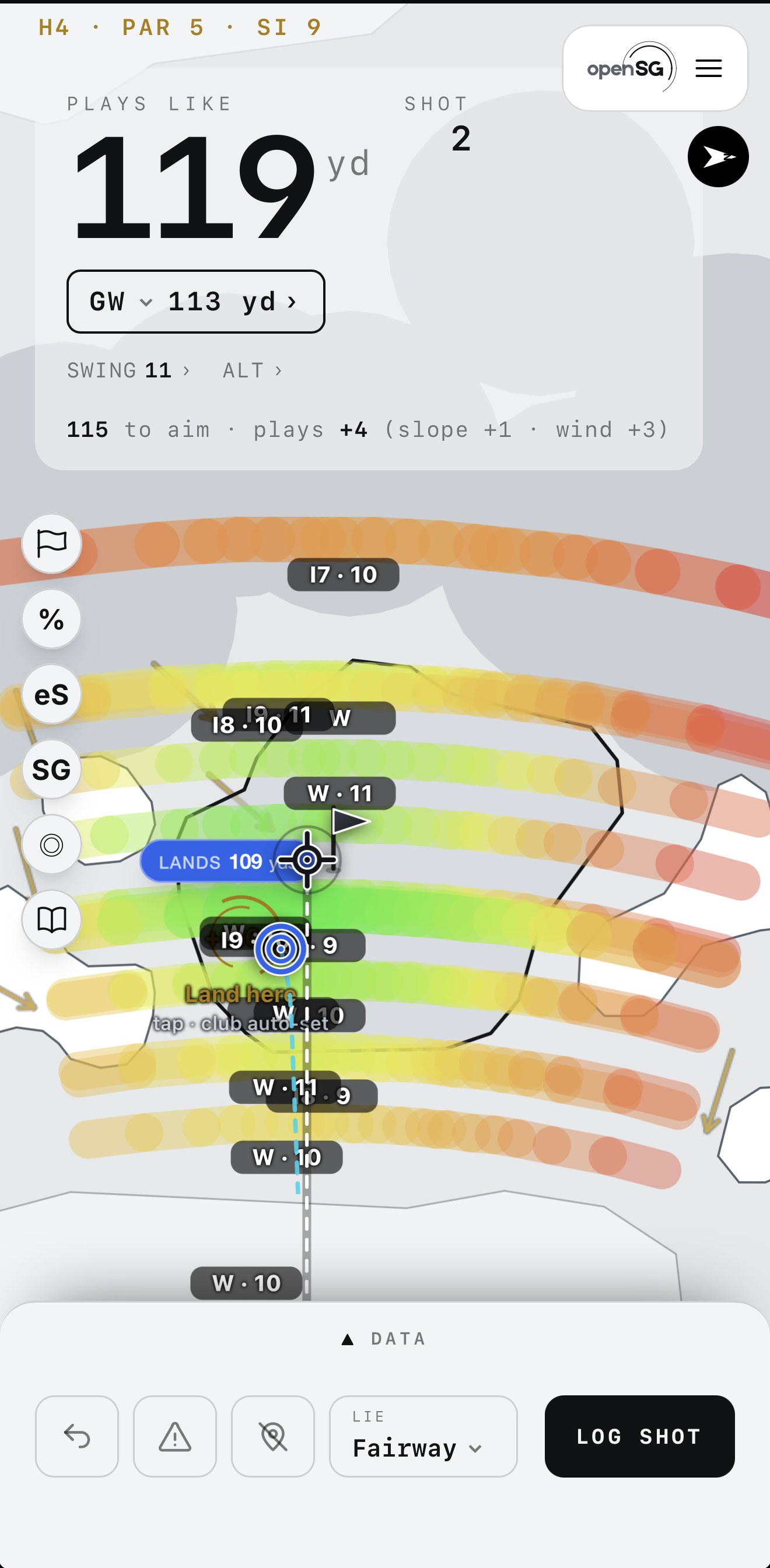
On an approach, we don't lock you to one club. We gather every club and swing in your bag that can reach the green, each with its own carry distance and its own cloud. That includes shorter swings you've logged, like a three-quarter or half wedge. For each one, we sweep the aim across a band around the green, roughly 25 yards either side of center, and score every candidate with the full 240-sample treatment. The winner is the club, swing, and direction with the lowest average.
That's why the app might tell you a three-quarter wedge to a spot beats a full wedge that flies long into a bunker. It isn't just aiming a club you picked. It's picking the club too.
The lateral sweep isn't evenly spaced. The best aim almost always sits near the middle of the green, and the edges only exist to bail out around trouble. So we scan the middle finely, every two yards, and leave the wings coarse at five. Dense where the decision is close, cheap where it isn't.
Most of the time the winner is near the center, which is right and a little boring. The interesting cases are when it isn't. A front pin tucked behind a bunker, and the sim quietly nudges your aim to the fat of the green, because the shots that miss long are so much cheaper than the ones that catch sand. You didn't do that math. The cloud did.
We paint the result as a heat map on the green: green where aiming is cheap, red where it's expensive. And drawing it costs almost nothing, because we already did the hard work when we picked the club.
Think about what choosing between a full wedge, a three-quarter, and a soft nine actually took. We swept each club's aim across the green and scored every candidate. That sweep is the expensive part, and we ran it once per club that reaches. Each sweep is a strip of already-scored points at that club's landing depth. So instead of throwing that away and re-scanning the whole green, we keep it. We lay each strip on the ground that club lands on, tint every point by its SG on one shared color scale, and blend the strips into a single wash.
Where two clubs land close together, their strips overlap and merge, so the map reads as one continuous surface. Where no club in your bag can reach, the ground stays unshaded. That gap is on purpose. We could fill it by guessing a score between the clubs on either side, but that would be inventing a number for a shot you can't hit. The wash only shows SG for ground a real club and swing of yours actually lands on. It's a picture of your options, not a guess about the whole green.
And because each band is a club's landing strip, the map knows which club drew it. Every band is labeled with its club and swing, and tapping the label picks that club and snaps your aim to its best spot, the same way the club fan works on tee shots and lay-ups. The heat map isn't next to the decision. It is the decision, drawn.
Tee shots and lay-ups: a fan of clubs
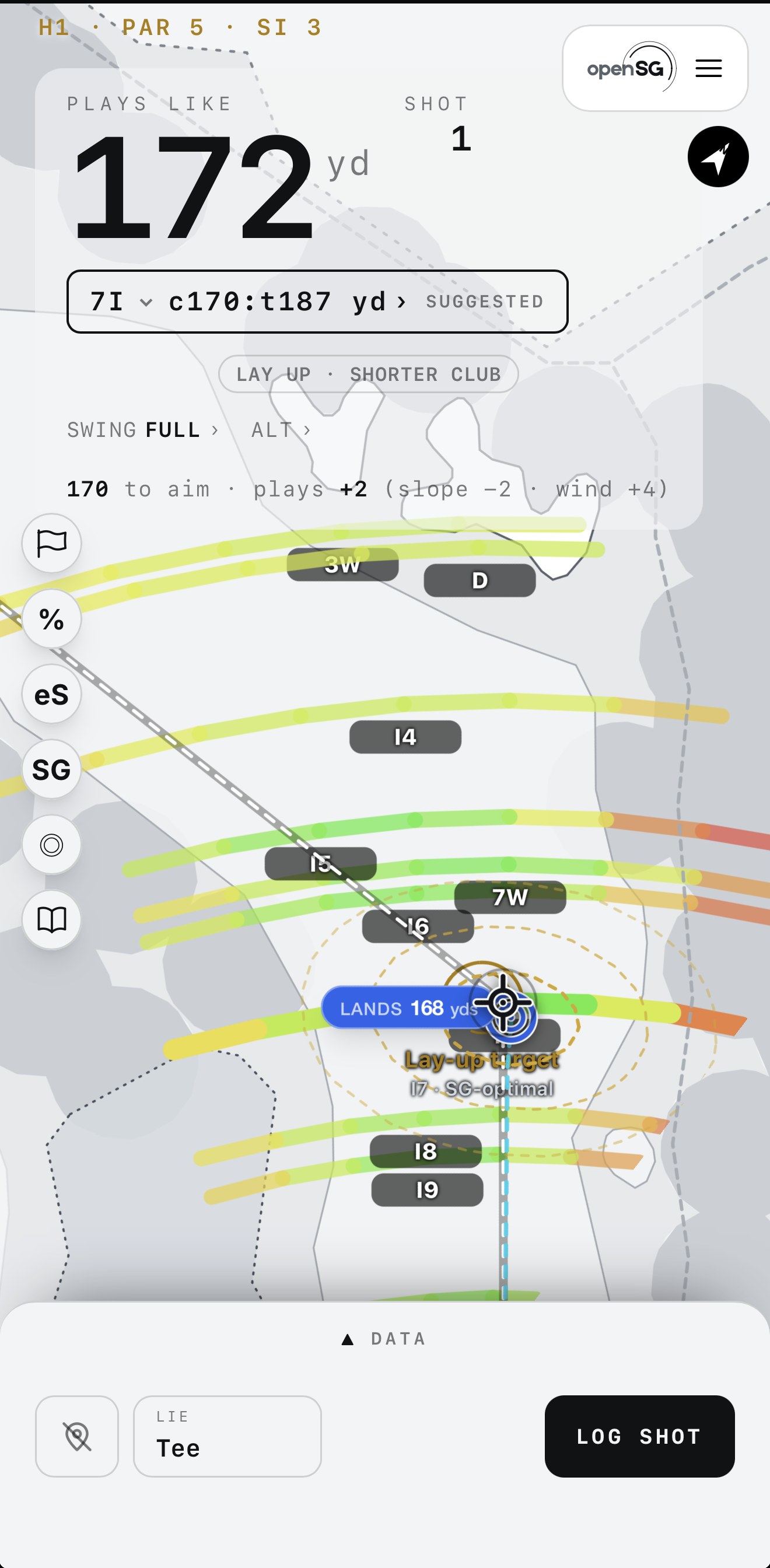
Off the tee, or on a long lay-up, "aim at the flag" is meaningless. You can't reach it. So the question changes from where on the green to which club, and pointed where.
We list the clubs in your bag whose carry lands in the lay-up corridor, from a sensible floor up to a full send. Each club becomes an arc, a slice of a circle at that club's carry distance from the ball. We sweep the aim along each arc, score every point with its own cloud (a shorter club has a tighter cloud, which the sim respects), and put them all on one shared color scale. The greenest arc is the best club. The greenest point on it is the best direction. That point gets the ring, and that's your aim.
This is why a lay-up can be "7-iron to a spot," not "hit it 210." It's choosing a club and a line together, and it will happily tell you the shorter club is smarter when the numbers say so.
Register now and OpenSG runs this math for you on every tee and every approach — no chalkboard required.
Hazards just fall out of the math
We never wrote a rule that says "avoid water." We didn't have to. Water and out of bounds simply cost a penalty stroke plus the shot you play next, so any sample that finds them drags the average up hard. A bunker isn't a penalty, just a worse lie, so it costs a little. The optimizer routes you around trouble because trouble is expensive, not because it was told to fear it. That's the nice thing about scoring in strokes. The strategy is emergent.
Trees are the hard part
Water is easy, because it only matters where the ball lands. Trees are brutal, because they matter where the ball flies.
A ball can land in a good spot after clipping a branch on the way. If we scored only the landing lie, we'd credit a shot that flew through a tree line as a clean fairway shot, which over-rewards any aim whose spread leaks over the trees, and cutting the corner on a dogleg is the tempting, wrong extreme.
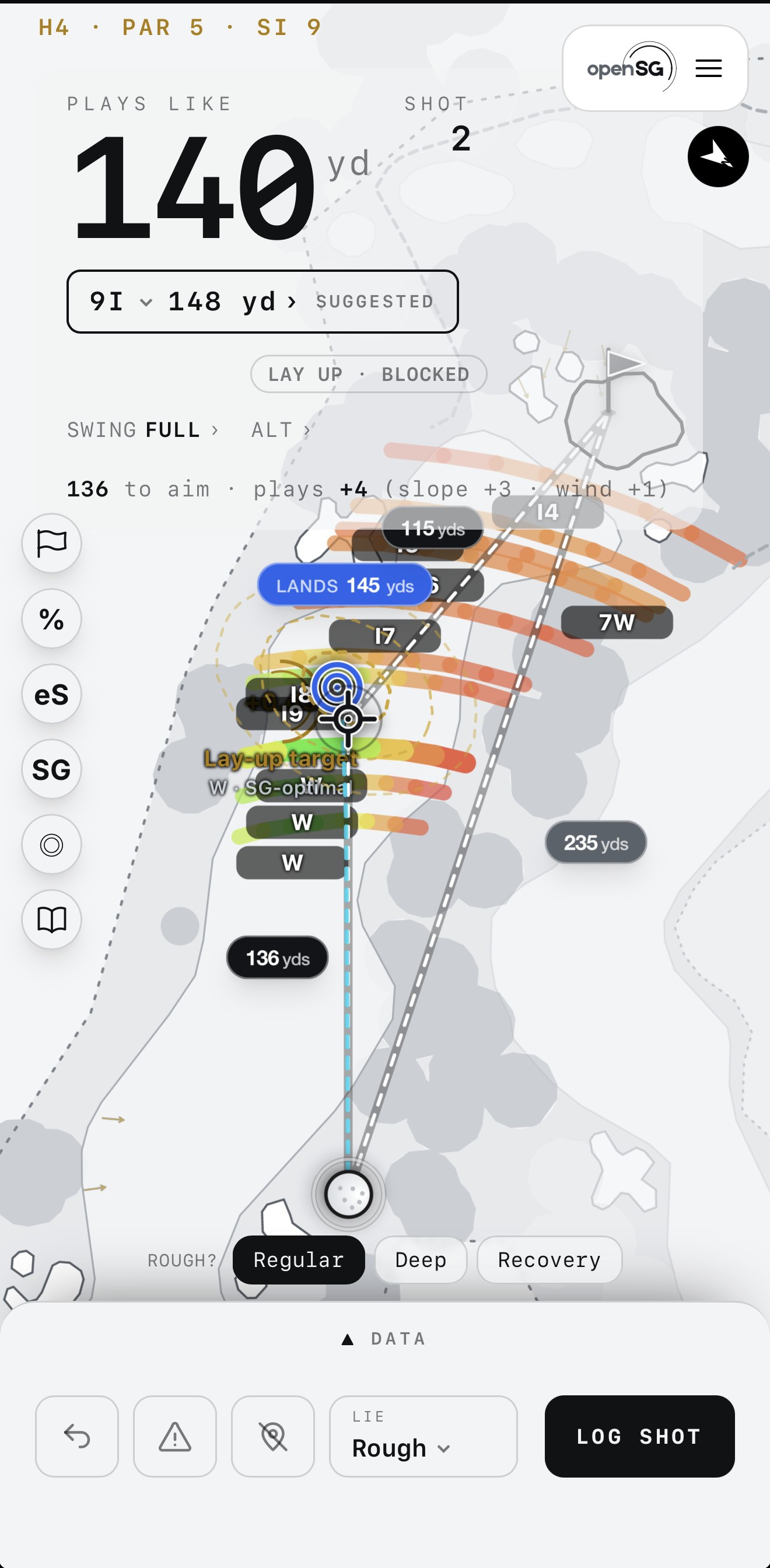
So every sample checks its flight path. If the line from ball to landing crosses a tree canopy, we split that shot into three outcomes and average them. It flies clean through. It deflects and drops short. Or it hits and falls straight down into a recovery lie. The mix depends on where along the flight the tree sits.
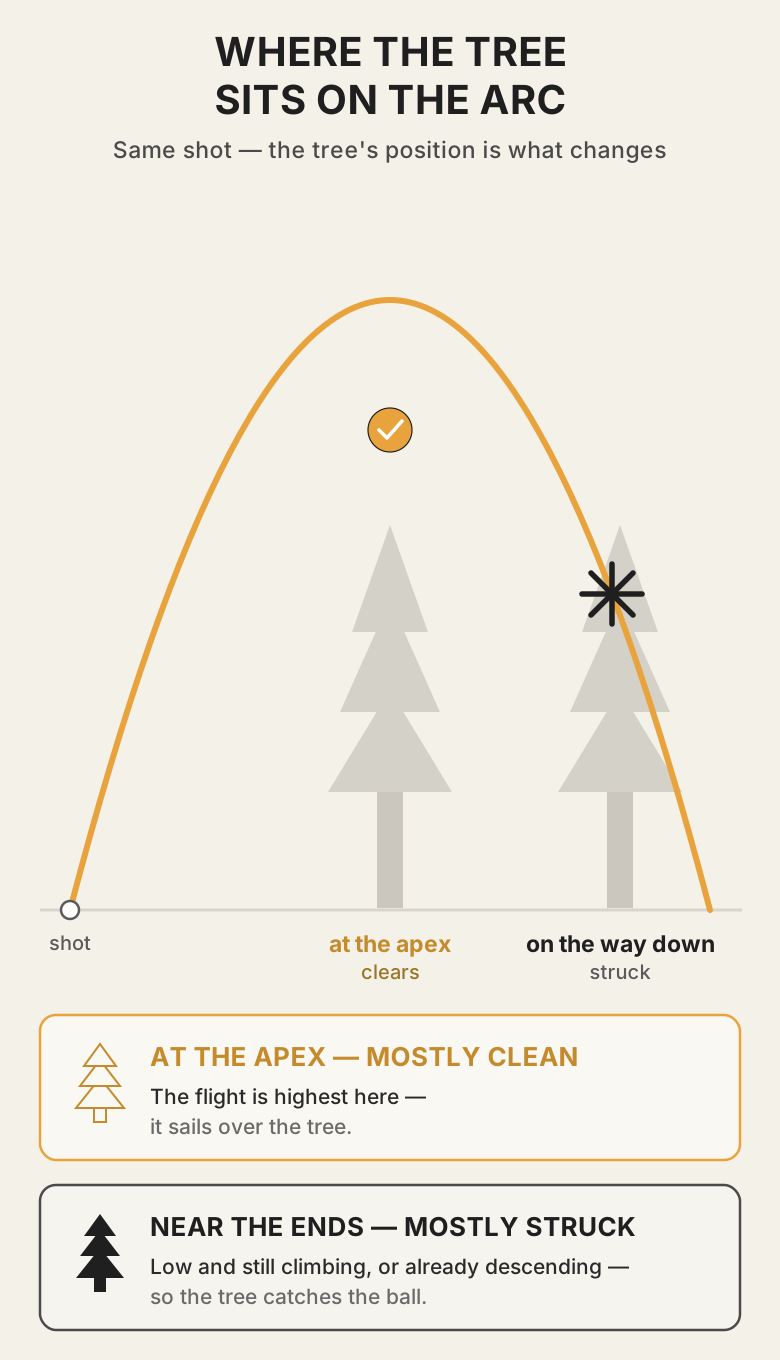
Think about the arc of a shot. Near the top, you're most likely to clear the canopy. Near the start you're still climbing, and near the end you're descending right into it, so those are where you get eaten. We model that as a tent: safest when the tree sits around the high point of the carry, worse at either end.
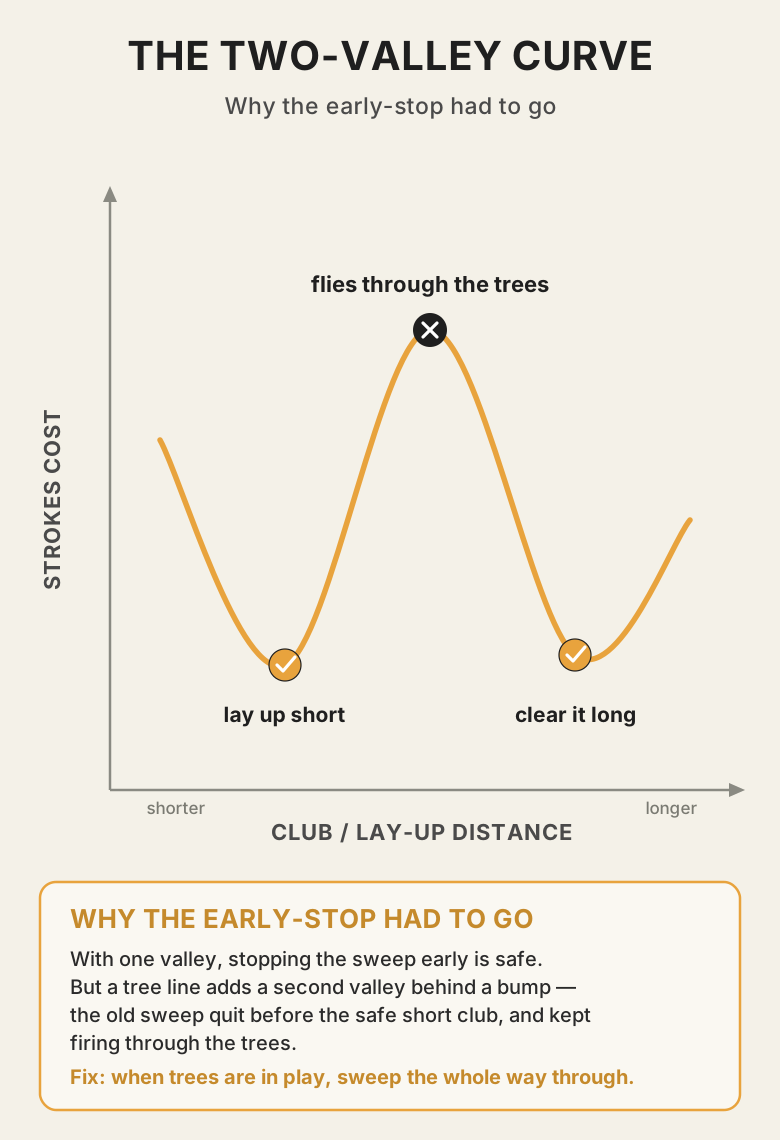
The nice side effect is that this sorts clubs for free, with no trajectory physics at all. Take the same tree. A longer club puts it at a smaller fraction of its carry, closer to the safe apex. A club that lays up short never reaches it. So without simulating a single parabola, the model already prefers the club that flies over the trouble, or the one that stops short, and penalizes the one that would rattle through at the worst height. We also treat a dense wood harder than a single tree, because you can sometimes sneak past one trunk but never thread a forest.
Doglegs
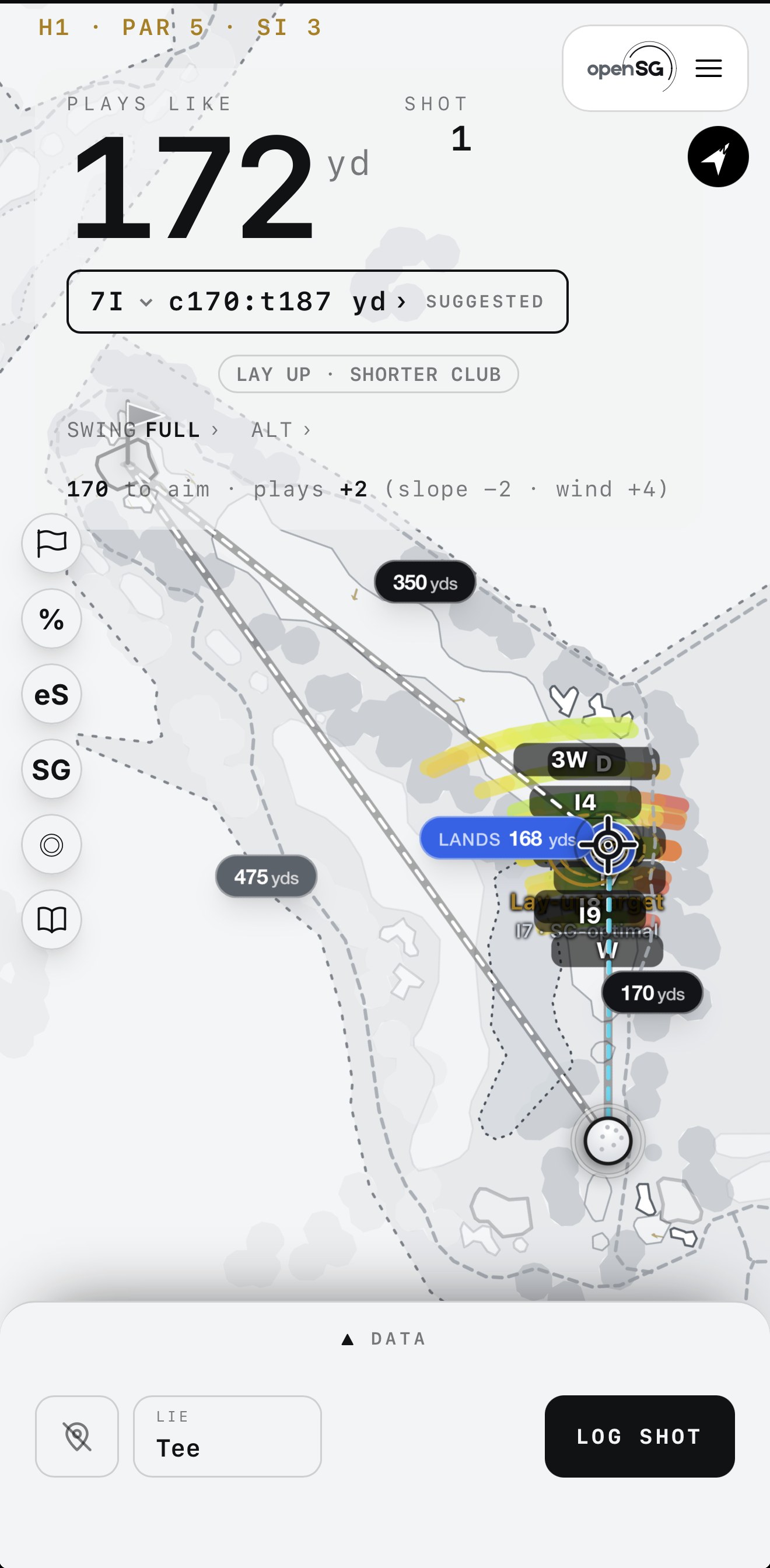
A dogleg would fool a naive aim system, because the straight line from ball to pin runs through the woods on the corner. So we aim along the fairway's centerline instead. A club's carry distance meets that bent centerline and follows it around the corner, so your target sits on the fairway where you'd actually play. And because the inside trees now cost real strokes, cutting the corner has to genuinely pay for its risk instead of looking free.
Go for it, or lay up?
When the green is reachable but guarded, we run both plays and compare them head to head: the best aim that goes for the green, and the best lay-up. We only recommend laying up when it wins by a real margin, not a rounding error. No drama, just two averages side by side.
Fast enough to trust, right there on the tee
The best part is where all of this runs: on your phone, during the round, in a few milliseconds, with no signal required. Courses eat cell service, so everything is self-contained and offline-safe. You get an answer the instant you need it, standing over the ball.
It stays that fast because the expensive step — sweeping every club and every aim — runs once and is reused everywhere. Nudge the ball on the map and the recommendation and heat map redraw instantly, because the hard work is already done. One sweep places your aim and paints the map.
And it's been walked onto real holes, over and over. A lot of the model's polish came from carrying a phone around actual courses, watching where the advice held up, and tightening it. One case worth calling out: on a hole with trees mid-flight, the smart play is often a shorter club that stops well short of the trouble. We made sure the engine always searches deep enough to find that safe club rather than settling for a bold line through the branches — so when the app tells you to fire over trees, it's because the numbers genuinely favor it, not because it stopped looking.
Where it keeps getting smarter
The recommendation is already solid for the shots you hit most. A few refinements are on the roadmap, and it's worth knowing where they'll help.
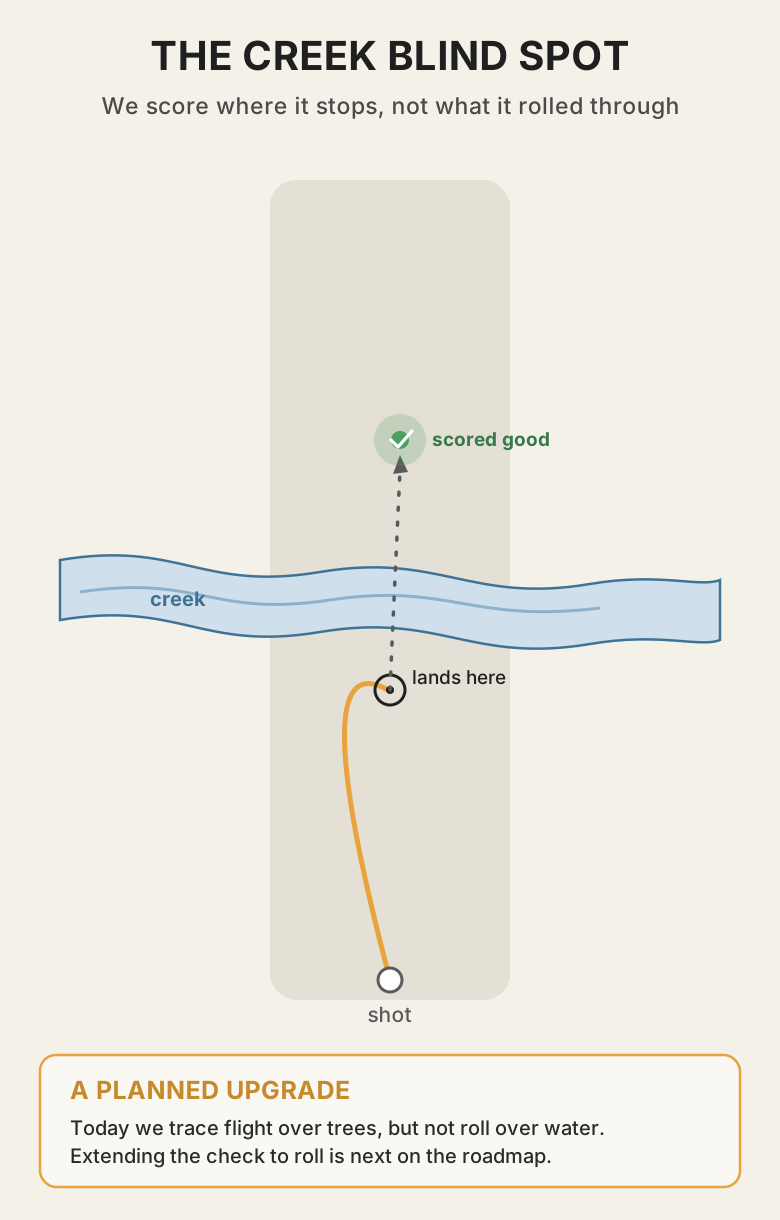
The most interesting one is water on the ground. Today the sim scores where your ball comes to rest, which is exactly right for almost every shot. The case we want to sharpen: a ball that lands safely on the fairway and then rolls across a narrow creek to the far bank, or trickles back into a hazard. Right now that roll isn't traced over water the way flight is traced over trees, so on a hole where a creek cuts the fairway and the ground runs toward it, the app can read a touch optimistic. Extending the flight-path check to roll is a planned upgrade.
Rollout is also richer on approaches than on lay-ups today. An approach runs the ball out down the real slope of the green, using the elevation grid, before deciding where it rests. A lay-up currently rolls it forward flat. Bringing that same slope-aware rollout to lay-ups is next, and it'll catch the case where a lay-up lands on a downslope and releases toward trouble.
The tree model, as mentioned, ranks clubs by where the tree sits along the carry rather than simulating your exact launch angle. It nails the club-vs-club comparison that matters, and once launch data is available it can get even more precise on any single tree.
And the engine leans on your dispersion cloud, which has a wonderful property: the more you play, the sharper it gets. A brand-new club you've hit six times is mostly an estimate; a club with a season of shots behind it is dialed in. Wind and turf firmness aren't fully folded into the roll yet either. None of these change the shape of the advice — they just mean the number keeps tightening as the data grows.
Like this kind of deep dive? Read more on the OpenSG blog.
How to play it
The recommendation is an average over your own scatter — the score you'd shoot if you played this shot a hundred times. That's exactly the number you want most of the time.
Trust it in a normal round where you want the lowest score over eighteen holes. Trust it especially when it tells you to lay up or take less club, because that's the advice human ego is worst at giving itself. The number is quietly counting the double bogeys you don't see.
Keep your own read for a few honest cases. When you need a birdie on the last hole and second place is worthless, you want the boldest line, not the cheapest average. When you know something the map doesn't — a firm downslope, a wind that just came up — trust your eyes. When you've hit a club only a handful of times, the model is still learning your shape. And when the lie is genuinely weird — down in a divot, or ball above your feet on a steep bank — remember the sim assumed a normal swing.
The app isn't trying to hit the shot for you. It's trying to tell you the truth about the odds, so that when you do something bold, you're choosing it on purpose.