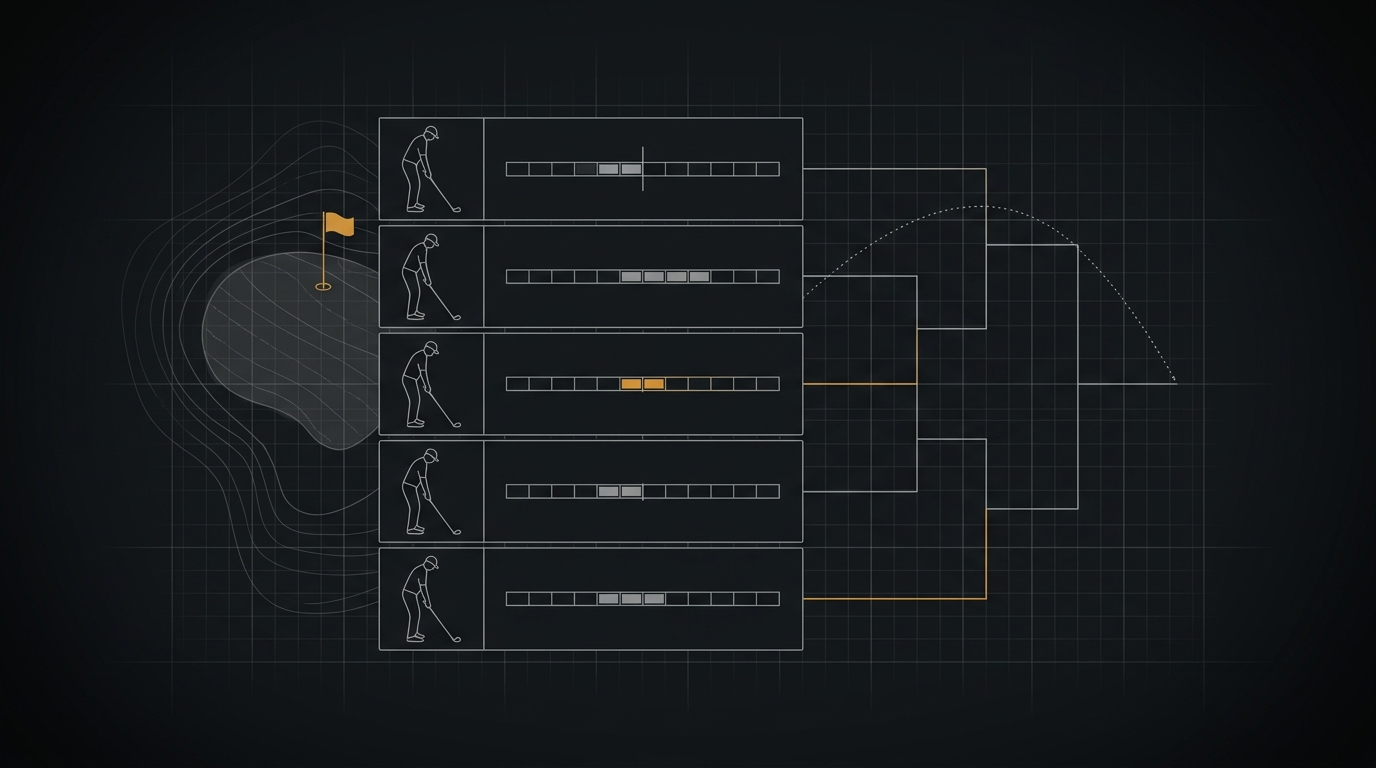
Every golf coach on earth, from the volunteer running a high school JV team to the captain of a Ryder Cup side, eventually stares at the same problem. You have more players than spots, or the same players in a different order, and you have to decide two things: who plays, and where do they go. Who tees off first. Who you sit. Who you pair with whom in a four-ball. Who you trust with the anchor match when the whole thing is on the line.
It's the oldest question in team sport, and golf makes it uniquely hard, because golf is an individual game wearing a team jersey. A player's number — their scoring average, their handicap — is real, but it was earned alone, on courses that aren't the one you're about to play, in formats that aren't the one you're about to play. The gap between "this player is good" and "this player is the right pick here, today, in this format" is where all the interesting coaching lives.
This post walks up the ladder — high school, college, the pros — showing what tools coaches actually reach for at each level and how the decision gets made. Then it asks the honest question: where does something like OpenSG fit, is it overkill for a high school team, and is it anywhere near enough for a tour pro.
High school: the scoring average and the qualifying ladder
Start at the bottom of the ladder, where the budget is roughly zero and the coach might also teach chemistry.
At the high school level, lineup selection is almost entirely about one number: scoring average, usually earned through qualifying rounds. Most programs run a rolling ladder — you play your way onto the varsity spots by posting the lowest scores in team qualifiers, and if someone below you beats your average over the next couple of weeks, they can take your spot. Coaches are advised to make the process large enough to be fair (36+ holes for the top spots, fewer for the back end) and, above all, repeatable and understandable. That transparency is a feature, not a bug: nothing kills a locker room faster than a lineup that looks arbitrary.
The tooling is correspondingly light. Handicaps come through GHIN, the USGA's handicap system, though in-season lineups usually run on gross scoring average, not handicap index. Live tournament scoring and event administration increasingly run through iWanamaker, which has become the default platform for high school golf — by some counts it's used by roughly three-quarters of U.S. high school teams and is the designated system for a long list of state athletic associations. Recruiting-facing tools like Golfstat's PREP Report help a junior see what scores they'd need to play at a given college. And plenty of coaches never leave a spreadsheet — qualifying scores in, averages out, top names play.
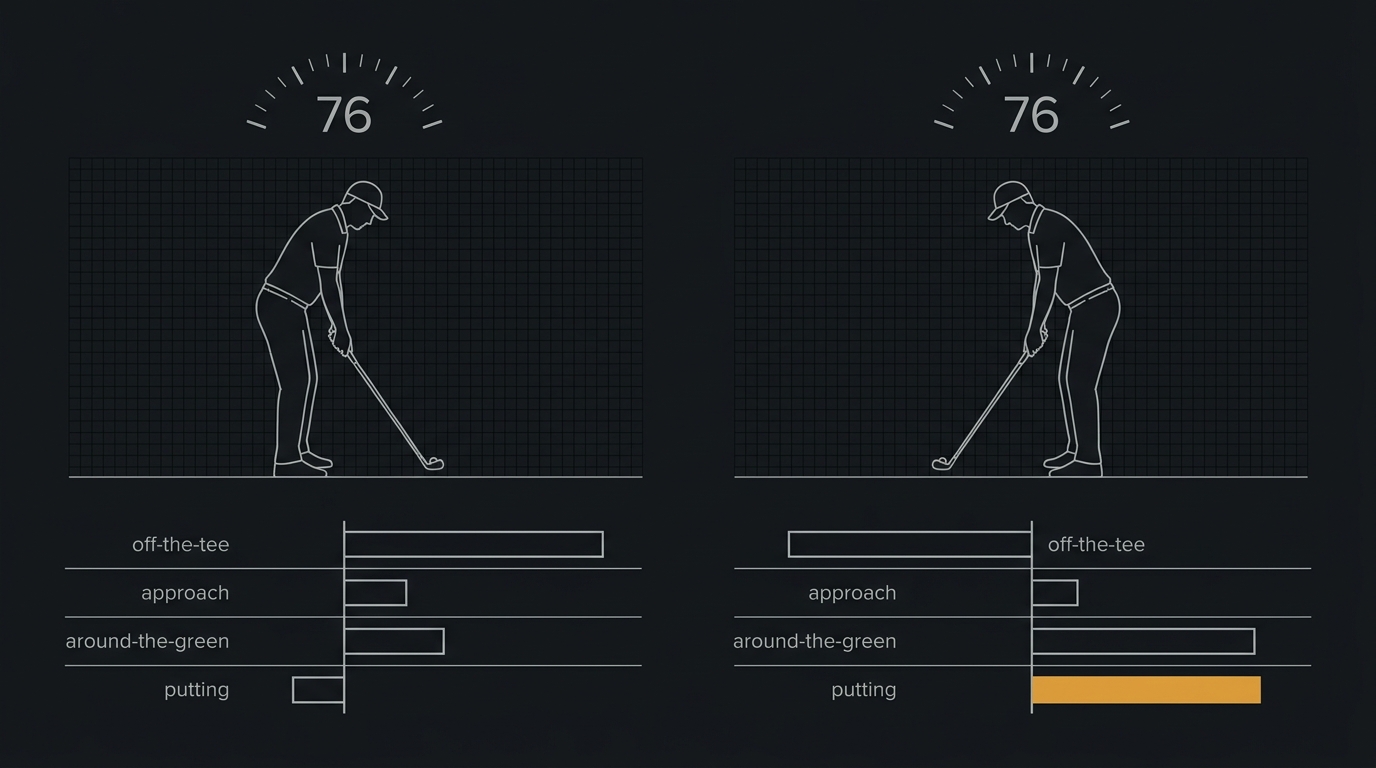
Here's the thing, though. Scoring average tells you who is shooting low. It tells you almost nothing about why, or about what happens on a different course. Two players averaging 76 can be completely different golfers — one bombs it and can't putt, the other is a magician around the greens who gives up 30 yards off the tee. On a tight, penal course, one of them is a liability and the other is gold, and their identical averages hide that completely. At the high school level that blind spot mostly doesn't matter, because the margins are wide and the schedule is short. But it's the exact blind spot that everything above high school spends money to close.
New to strokes gained? Learn how OpenSG works — real strokes gained for every player, computed from every shot.
College: the strokes-gained arms race
Step up to NCAA golf and the picture changes overnight. College golf is, quietly, one of the most analytically sophisticated corners of the sport, because the coaches are full-time professionals, the budgets are real, and — with teams fielding five players and counting the best four scores each round — the difference between your 4th and 5th player can decide a conference title.
The backbone is scoring and rankings. For over three decades that was Golfstat, founded by Mark Laesch in the 1980s and the official scorer of NCAA championships. In 2023 the contract briefly passed to a startup called Spikemark, whose system famously fell over at launch, and by that October the NCAA had handed scoring and rankings to Clippd. What makes Clippd notable isn't just the scoreboard — its ranking work is guided by Professor Mark Broadie of Columbia, the man who invented Strokes Gained, and it blends finish position, stroke differential, and strength of field rather than raw scoring average. A 71 at a brutal event against a stacked field is worth more than a 68 at a soft one, and the ranking knows it.
On top of the rankings, college programs layer real shot-tracking and course-management tools:
- Clippd doubles as a team analytics platform, pulling in data from Arccos sensors, Garmin, TrackMan and manual entry to produce a "Shot Quality" metric on top of strokes gained, with free coach dashboards for lesson notes and practice plans. It reports use by well over a hundred college programs.
- DECADE Golf (Scott Fawcett's system) is less a stat tracker than a decision framework — the acronym stands for Distance, Expectation, Correct target, Analyze, Discipline, Execute — a statistically grounded set of rules for where to aim and how to manage risk, taught to a huge number of college and tour players. It's about training the player's brain, not ranking the roster.
- Anova, UpGame (now part of TrackMan), and shot-capture devices like Arccos and Shot Scope all produce strokes-gained breakdowns so a coach can see where a player is winning and losing strokes: off the tee, approach, around the green, putting.
But here's what's revealing: even with all of this, the lineup is still mostly decided by qualifying. A common pattern is to take the top four by qualifying score and give the coach discretion over the fifth spot. The analytics inform who a coach develops, what a player practices, and how they read a matchup — but the top players still generally earn their spots by posting scores, for the same reason high schools do it. It keeps the room honest. What strokes-gained data adds is the why underneath the who, and the ability to spot the player whose scoring average undersells them because they're bleeding strokes in one fixable category.
The pros and the Ryder Cup: where the picks get interesting
At the top, two things happen at once: the data gets perfect, and the decisions get harder.
The data gets perfect because of ShotLink, the PGA Tour's laser-and-camera system that records the exact coordinates of essentially every shot hit in competition. ShotLink is what made Strokes Gained a precise, ubiquitous metric — Broadie's book Every Shot Counts analyzed roughly four million Tour shots and took the idea mainstream, and it's now the common language of professional golf. Public sites like Data Golf build predictive models on top of it, estimating each player's skill profile, projecting performance, and even publishing a course-fit tool (interestingly, Data Golf's own research finds course fit has less predictive power than intuition suggests — a useful humility check for everyone downstream).
So for stroke-play tournaments, the "lineup" mostly answers itself: the best players by the numbers are the best players. The genuinely hard version of the problem shows up in team match play, and nowhere more than the Ryder Cup.
Ryder Cup selection is a two-part machine. Each 12-player team is built from six automatic qualifiers plus six captain's picks. The automatics are earned on a points list — in 2023 Europe drew from separate European and World points lists, and for 2025 they simplified to a single unified Ryder Cup Points List. The picks are where the judgment lives, and captains agonize over them. In 2023 at Marco Simone, Luke Donald used his six on Ludvig Åberg, Tommy Fleetwood, Nicolai Højgaard, Shane Lowry, Justin Rose, and Sepp Straka; in 2025 at Bethpage Black — with Keegan Bradley captaining the U.S. after Tiger Woods declined — Donald brought back essentially the same core and Europe won 15–13 on American soil.
But selecting the twelve is only half of it. The Ryder Cup is won and lost on pairings — who plays foursomes with whom, who sits a session, who anchors the Sunday singles — and on course setup, because the home captain gets to shape the golf course to suit his team.
This is exactly where analytics quietly took over. Since 2015, European captains have leaned on an outside analytics firm — the 15th Club, an offshoot of a soccer-analytics company (the 21st Club) now part of the Twenty First Group. Their proprietary index adjusts performance for course difficulty, weather, and field strength, and it produces the unglamorous work: automatic-qualifier forecasts, wildcard support, and specific pairing recommendations. Europe also has a human face for this — vice-captain Edoardo Molinari, a tour winner who runs his own stats models and served as the team's in-house analyst in both 2023 and 2025. For Rome he chewed through three years of Marco Simone data down to absurd specificity (how candidates performed on downhill, left-to-right seven-footers when the greens ran fast) and fed Donald biweekly reports on who fit the course. Course fit becomes a weapon: at recent home Cups, Europe has set up the golf course to reward accuracy and stacked the roster with straight hitters, deliberately blunting the Americans' length advantage.
And when a captain ignores the math, it shows. At Bethpage in 2025, Bradley sent out Harris English and Collin Morikawa together in foursomes — twice — a pairing that Data Golf's public "Optimal Pairings" model had ranked dead last out of 132 possible U.S. duos. Europe won. Correlation isn't proof, and captains will always keep the final call. But the modern Ryder Cup is a running, public argument about how much to trust the model, and the side that trusts it more has been winning that argument.
Coaching a team, or just chasing your own numbers? Register now and start building strokes-gained profiles you can actually act on.
The through-line, and the gap
Walk the whole ladder and one thing is constant: strokes gained is the shared language. It's the metric that survives from Broadie's chalkboard to the NCAA ranking to the Ryder Cup war room, because it's the only number that tells you not just how many strokes a player gained or lost but where — which is the only information that actually helps you make a decision.
More where this came from — browse the rest of the OpenSG blog.
And walk the ladder again and one gap keeps reappearing, unfilled, at every level below the very top: matching a player's profile to a specific course and a specific format. High schools ignore it. College programs mostly handle it by feel and film. The pros solve it with a bespoke consulting firm and a captain's intuition. There is real public methodology for it now — Data Golf even documents how it optimizes four-ball pairings, valuing within-round variance (a boom-or-bust player is worth more in a better-ball format) and "ham-and-egging," the negative hole-to-hole correlation that lets one partner cover the other's mistakes. But that lives in the pro-and-betting world. Nobody in the middle has a tool that takes the strokes-gained profiles a coach already has and answers: given this course and this format, who is the right lineup, and who should I pair together?
Where OpenSG fits
That gap is the part of this problem OpenSG's coach tools are built around, so let me be specific and honest about what it does and doesn't do.
The foundation is the same as everywhere else: strokes gained for every player, computed from every shot. The difference is how the shots are captured. OpenSG gets shot positions from your phone's GPS rather than a ShotLink laser grid, so the precision is a notch below tour-grade — but it's the same strokes-gained math. And "a notch below" is measurable: peer-reviewed testing of GPS shot-trackers found a mean distance bias under one yard versus a laser, with error that grows on the longest shots (roughly ±9 yards at 200+ yards). That's plenty accurate to tell a bleeding approach game from a sharp one across a season, which is all a coaching decision needs. For a coach it means every kid on the roster generates the same category breakdown — off-the-tee, approach, around-the-green, putting — that college programs pay for, without anyone hand-entering stats.
On top of that, the coach side does two things the scoring-average world can't:
- Course-fit prediction. Instead of ranking players by a course-blind average, it reads the geometry and demands of the specific course you're about to play, weights each strokes-gained category by how much that course actually asks for it, and projects how each player's profile should perform there. The straight hitter and the bomber stop looking identical the moment the course gets a vote.
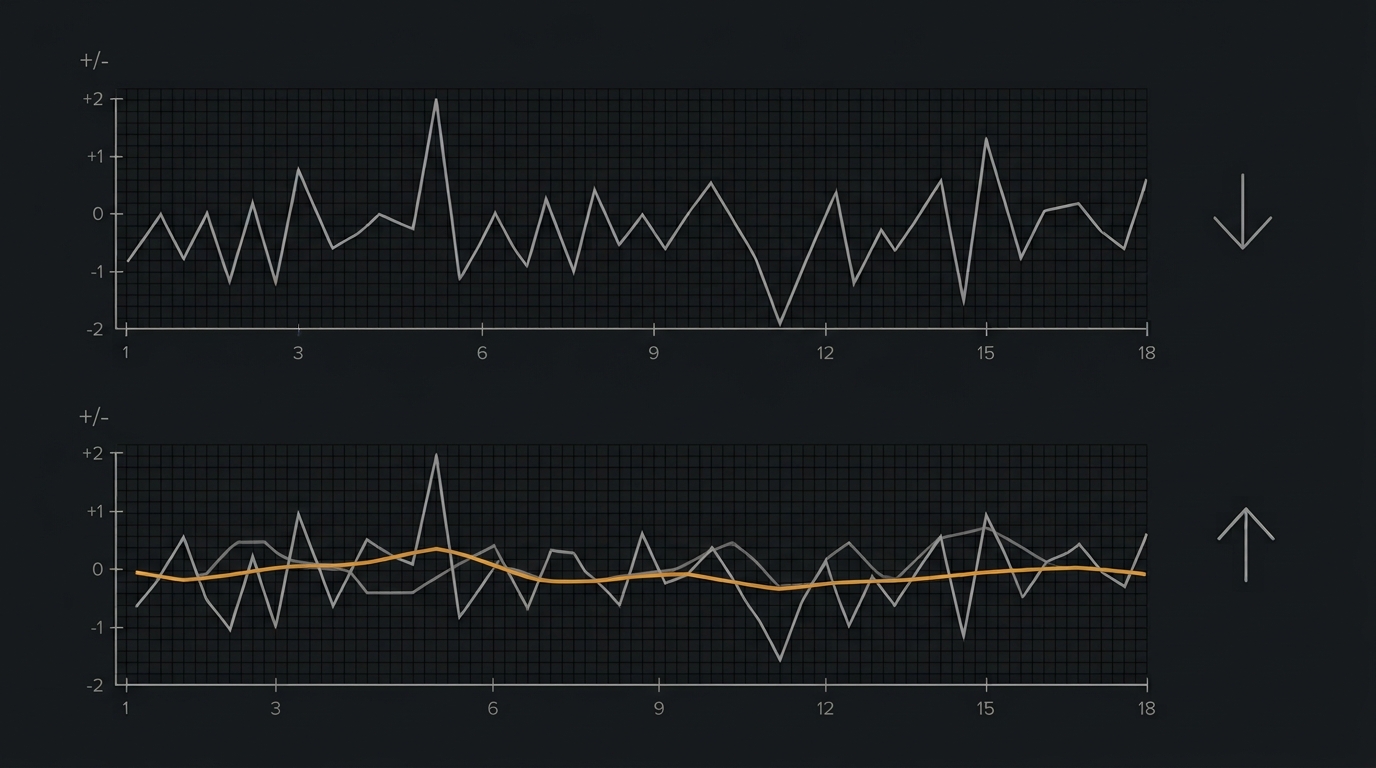
- Format-aware lineup and pairing help. Stroke play, best-ball, match play, and scramble reward completely different things. In a count-the-best-scores format, the volatile boom-or-bust player the pros prize in four-ball is an asset; in straight stroke play that same volatility is a liability. The lineup tools weigh players against the format you're actually playing and can suggest pairings, not just a ranked list.
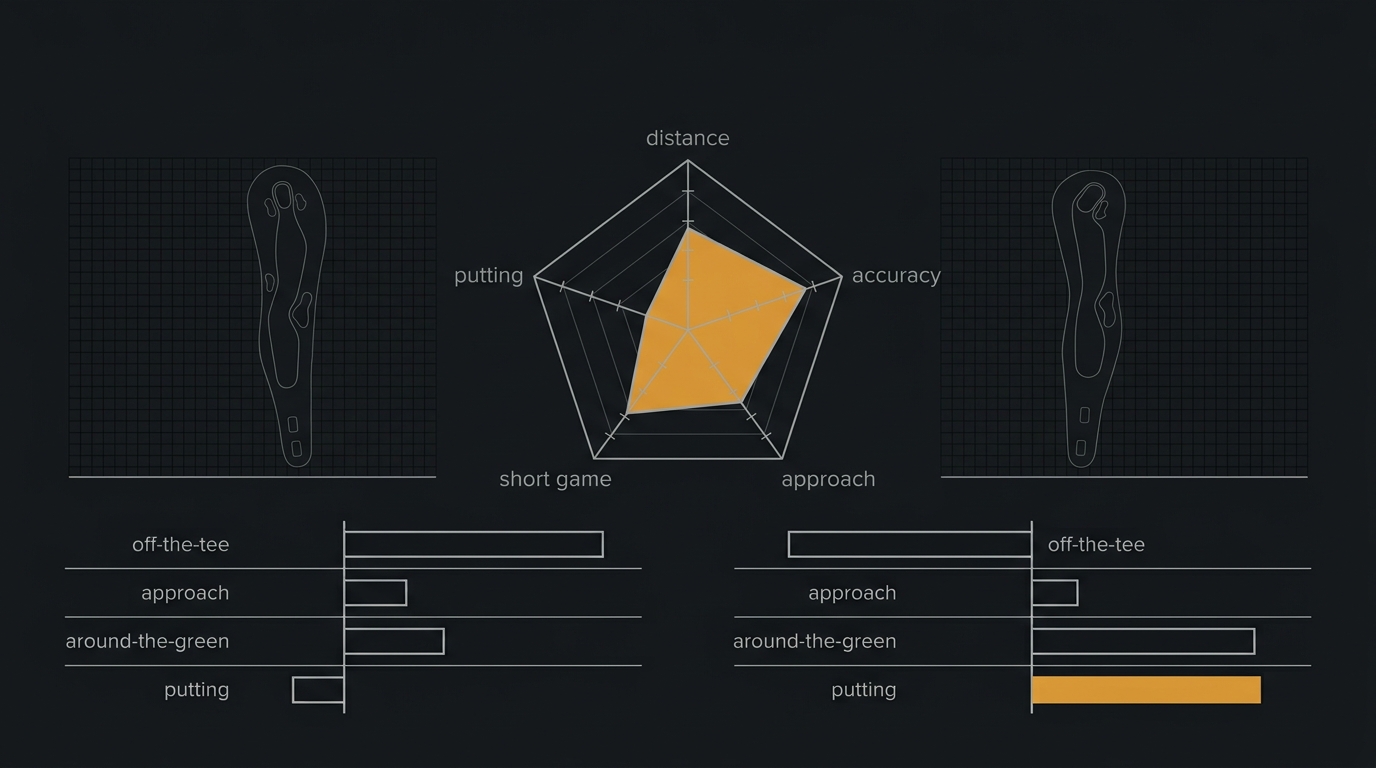
That is, deliberately, a small-scale version of what Twenty First Group does for Europe — course-fit and pairing optimization grounded in real per-player data — pointed at a coach who has a roster and a spreadsheet, not a consulting budget.
So: overkill for high school? Enough for the pros?
Honest answers.
Is it overkill for high school? For picking the top six, mostly yes — a qualifying ladder is the right tool for that job, and it should stay. Where it earns its keep even at the high school level is development and the close calls: seeing that your No. 6 player is actually losing all their strokes putting and is a range session away from being your No. 3, or that your two similar-looking 78-shooters should be split up because one thrives on a course the other hates. It's not there to replace qualifying. It's there to explain it.
Is it enough for the pros? No, and it isn't trying to be. A tour team has ShotLink precision, a full-time analytics firm, and a captain whose intuition is itself a world-class model. GPS-based strokes gained and an automated course-fit read is not going to out-analyze Twenty First Group or Edoardo Molinari. What OpenSG does is take the shape of that professional workflow — strokes gained, course fit, format-aware pairings — and make it available three or four rungs down the ladder, to the college and competitive-junior coaches who have the same questions and none of the same resources.
Which is the real answer to who this is for. Not the Ryder Cup captain, who's covered. Not the high school coach picking a top six, who doesn't need it. It's the whole band in between — the coaches who field a team on a specific course in a specific format, and who are currently making that call with a course-blind, format-blind number:
- College programs (NCAA D1 through D3, NAIA, NJCAA). The clearest fit. Rosters field five and count the best four, so the 4th-vs-5th call literally decides events; the schedule runs on courses the team has never seen; and the staff already buys strokes-gained tools but still sets the lineup by qualifying score and gut. Course fit and format-aware pairing are the exact gap those tools leave open.
- Small-college and mid-major staffs specifically. The same job as the blue-chip programs without the Clippd-and-a-full-time-analyst budget. This is the workflow-in-a-box version of what Wake Forest or Georgia Tech can afford to staff.
- Elite junior programs and academies. AJGA-track players and academy squads who play enough tournament golf that their SG profiles actually mean something — and for whom college recruiting rides on knowing which parts of the game to fix, not just how low they shot.
- Contending high-school programs. Not the JV coach with a clipboard, but the state-contender staff whose schedule moves course to course and who wants to know why two 76-shooters are different players before sending them out on a track that punishes one of them.
- Club, league, and interclub team captains. Member-guests, league sides, and match-play teams, where the event is usually best-ball or scramble and format-aware pairing — who complements whom — beats seeding by handicap outright. This is the amateur echo of the four-ball "ham-and-egging" the pros optimize for.
What they all share is a coach who has looked at a row of nearly identical scoring averages before a big event on an unfamiliar course and thought: I know these numbers aren't telling me the whole story. I just can't see what they're hiding. Strokes gained is how you see it. The rest is just making it usable before the shotgun goes off.
OpenSG computes real strokes gained for every player from every shot, and its coach tools turn those profiles into course-fit and lineup decisions. Try OpenSG free and see what your numbers have been hiding.